What is the payment gateway fee
Payment Gateway fee is the processing charge applied on online payments.
Written by Sumit Kapoor
Introduction
When a student makes an online payment through Lynk, a payment gateway fee is applied to process that transaction. This fee covers the cost of securely handling the payment through banking networks, card processors, and UPI systems.
Lynk makes this fee fully visible so there are no hidden deductions or surprises during settlement.
With the payment gateway, students can use multiple payment options such as credit/debit cards, net banking, EMI, and UPI to complete their payments.
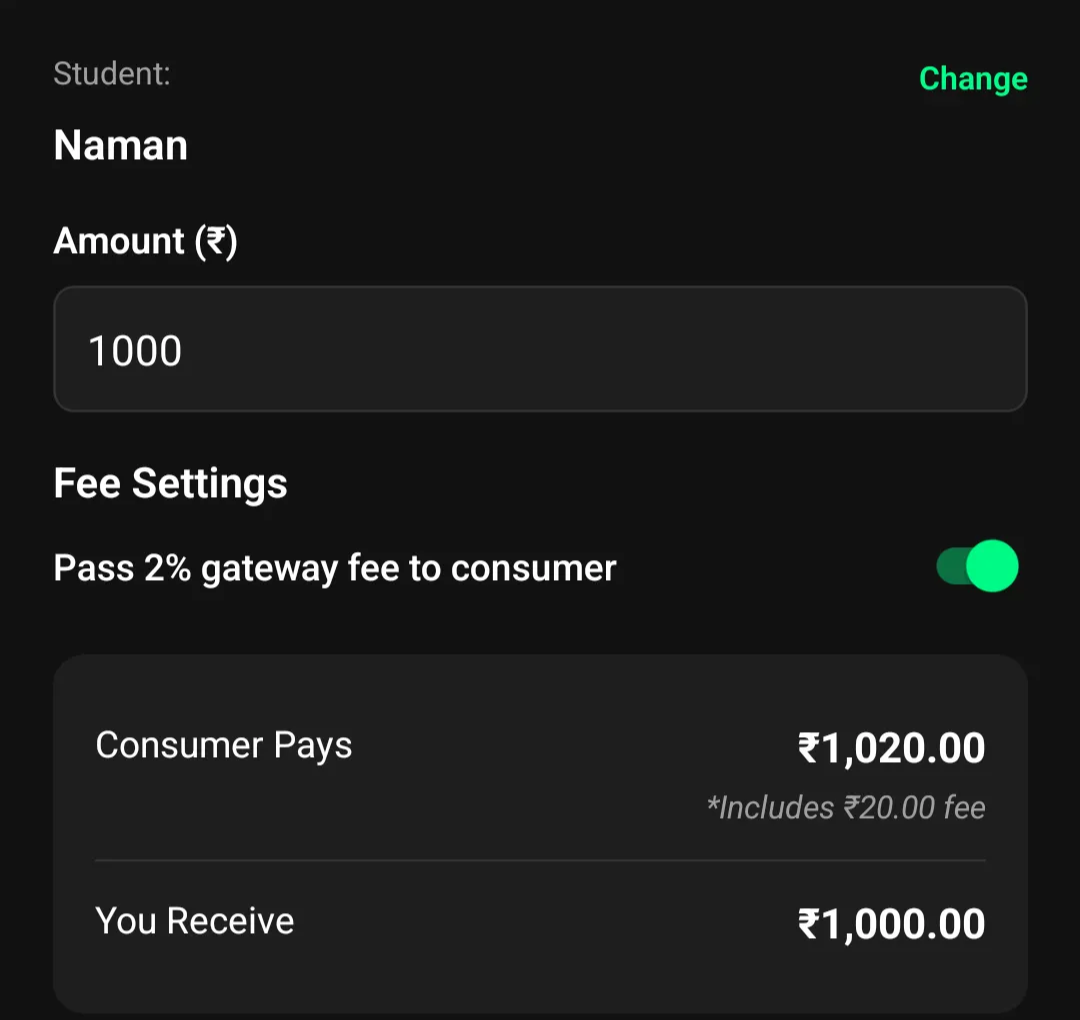
What the Payment Gateway Fee Represents
The payment gateway fee is a processing charge applied per transaction when an online payment is completed.
This fee:
Is calculated as a percentage of the base amount entered by the coach, based on the active plan
Applies only to successful online payments
Is charged for securely collecting and processing the payment
Gateway Fee Rate (Based on Your Plan):
Free Plan: 4%
Lite Plan: 3%
Growth Plan: 2%
The exact fee is shown clearly against each payment request.
How Gateway Fees Are Applied in Lynk
For every payment request, Lynk calculates the gateway fee based on your active plan at the time of requesting payment.
Depending on your setup:
The coach can absorb the gateway fee, or
The gateway fee can be passed on to the consumer
This flexibility allows you to decide how the cost of payment processing is handled.
Why Gateway Fees Are Shown Separately
The gateway fee is shown separately to coaches, not to students. For coaches, it helps:
Maintain clarity on deductions
Avoid confusion during payouts
Simplify reconciliation and accounting
You always know exactly how much was collected and how much was processed as a fee.
Summary
The payment gateway fee in Lynk is a transparent processing charge applied to online payments, based on your selected plan.
By clearly showing the fee per transaction and allowing flexibility on who bears the cost, Lynk ensures predictable settlements and complete visibility into your payment flow.