How insights are generated
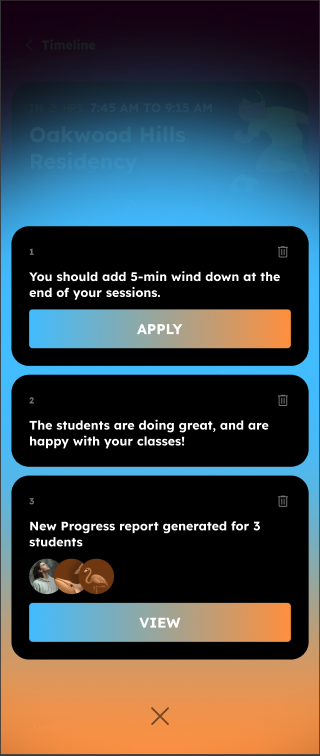
Insights come from patterns detected across notes, reports, and session history. They are generated and updated at a batch level and can be implemented in the upcoming session.
Written by Sumit Kapoor
Introduction
Insights in Lynk are generated by observing what actually happens across your sessions over time.
Every note you record, every report you generate, and every session you complete adds context that Lynk AI uses to understand patterns and suggest meaningful next steps.
What Data the AI Looks At
When generating Insights, Lynk AI reviews multiple connected data points, including:
Coach notes recorded after sessions
Attendance trends across sessions
Progress reports and skill evaluations
Session history within a batch
No single input is treated in isolation—the AI looks at how these elements relate to each other over time.
How Patterns Are Detected
The AI analyzes your data to identify:
Repeated strengths or improvements
Areas where progress may be slow or inconsistent
Attendance-related signals that affect learning continuity
Gaps between planned outcomes and observed results
These patterns help the system understand what’s working and what may need adjustment.
How Insights Are Created
Once patterns are detected:
The AI proposes focused suggestions for upcoming sessions
Recommendations are aligned to the batch and learner context
Suggestions evolve as new notes, reports, or sessions are added
Insights are refreshed automatically when new meaningful data is recorded.
What Insights Do Not Do
They do not modify past records
They do not auto-plan sessions
They do not override coach decisions
Insights are advisory, not prescriptive.
Summary
Insights are generated by reading your real coaching activity—notes, attendance, reports, and session history—and turning recurring patterns into practical suggestions. They help you decide what to try next while keeping full control in the coach’s hands.