Sample Gymnastics Curriculum for Beginners (Editable Template)
By Swathi N ·
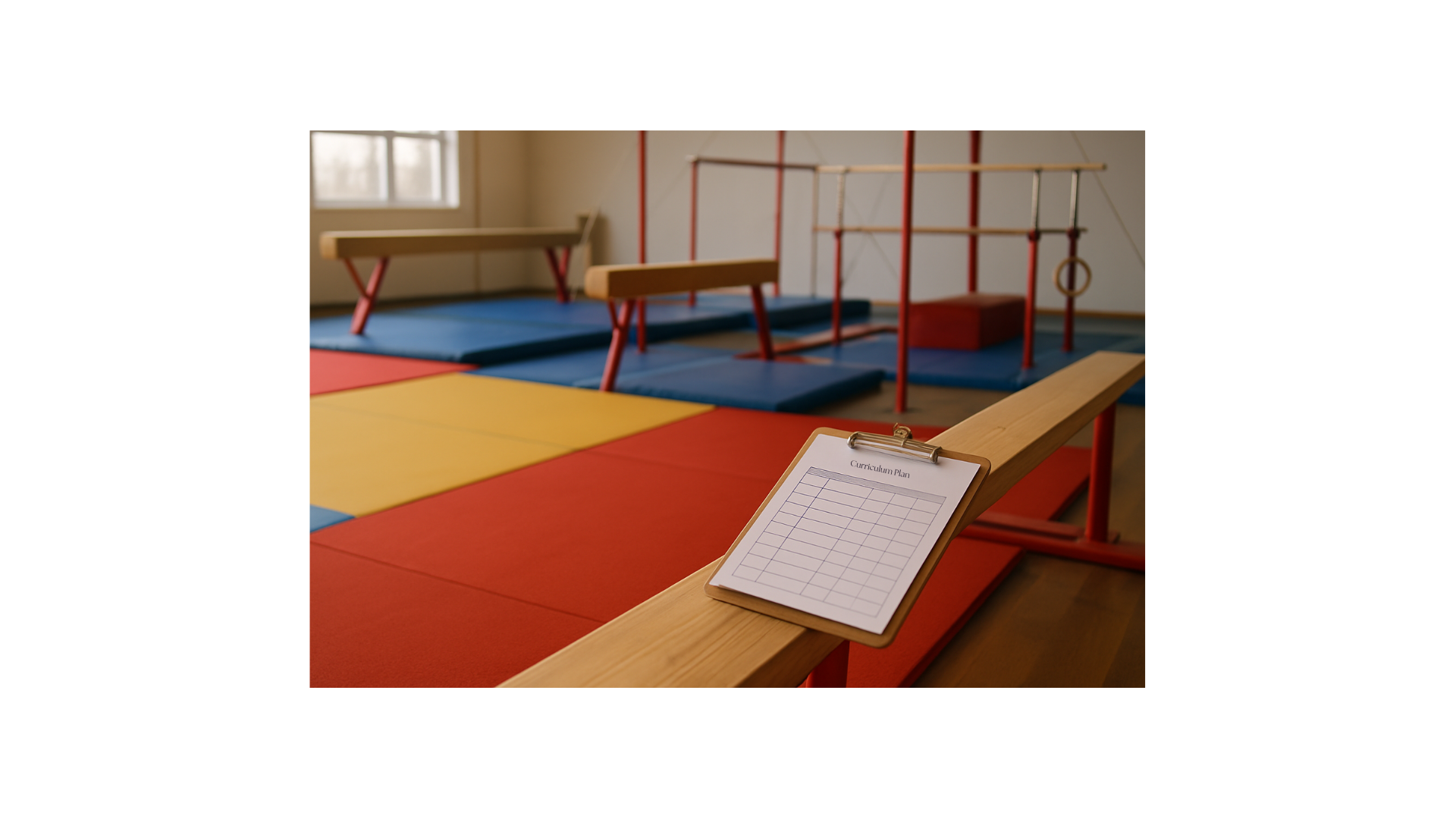
12-week beginner gymnastics curriculum you can edit today — skill progressions, drill ratios & lesson plans aligned to USAG Level 1–2 guidelines.
Picture the first day: eight kids bouncing on the floor mat before you've even called them to attention, two of them already attempting cartwheels with approximately zero technique, and one just lying face-down for reasons nobody can explain. That's where a beginner gymnastics programme starts. And if you don't have a clear structure walking in, those twelve weeks will evaporate faster than you'd believe.
This curriculum is that structure. Twelve weeks, built from scratch, ready to run — skill progressions, drill ratios, assessment checkpoints, and a lesson plan template you can copy and edit today. It's aligned to USA Gymnastics (USAG) developmental guidelines for recreational and pre-team Level 1–2 athletes, so you're not just winging the sequencing.
By week 12, here's what your students will actually be able to do: a short floor sequence performed start to finish, a 10-second handstand held against the wall, and both a forward and backward roll executed with consistent, repeatable technique. Not Olympic-ready. But genuinely competent — and more importantly, safe and confident in their own bodies.
That last part matters more than the skills themselves.
How this curriculum is built
The biggest mistake in beginner gymnastics curricula? Rushing to skill-work before kids have any real sense of their own bodies. You end up spending half the class correcting form on a skill the student wasn't ready for — and the habit bakes in anyway. This curriculum is built to avoid exactly that.
Movement before mastery. The first four weeks aren't about perfect form. They're about spatial orientation, body-awareness, getting comfortable being upside down and sideways and off-balance. Refinement comes later. It has to.
Age doesn't drive the progressions here — ability does. A 9-year-old and a 12-year-old who are both true beginners may share a class, and that's fine. The checkpoints ladder by what a student can actually demonstrate, not what grade they're in.
You'll notice the same skills showing up again and again across all 12 weeks — hollow body, tight body, handstand kick-up. That's deliberate. Week 2's hollow body drill is on the floor. Week 7, it's on the beam. Week 11, it's embedded in a back walkover prep. Same shape, completely different context. That's how you build transfer, not just repetition.
Every session runs a 20/60/20 structure. Warmup takes 20%, skill practice gets 60%, cool-down and review close out the last 20%. For a 30-minute class, that's 6 minutes / 18 minutes / 6 minutes. For 60 minutes: 12/36/12. Scale it to whatever you're working with — but don't gut it to make room for more skill time. The structure is the point.
Each week also flags the most common mistake coaches see at that stage. Not as a checklist item — as a coaching prompt. If you know what's going wrong before class starts, you can cue it early. Wait until after the pattern forms and you're already fighting an uphill battle.
Week 1–4: Foundation
Week One — Body Shape and Spatial Awareness
Here's something that catches almost every new coach off guard: beginners don't struggle with cartwheels or rolls — they struggle with just being in their body. Week one isn't about movement. It's about shape.
The three shapes you're building this week are tuck, pike, and straddle. That's it. By Friday, every student should be able to hit all three on command — no hesitation, no looking around at classmates for reference.
Skills on the roster: tuck shape hold (held for 5 seconds), seated pike stretch, seated straddle stretch, pencil jump, tuck jump, log roll, and forward roll on a wedge mat. Manageable list. Don't rush through it.
Your 60-minute class breaks down like this — 12 minutes of warmup, 36 minutes of skill practice, 12 minutes of cool-down. That middle block is where the real work happens, so protect it.
Watch the tuck shape closely. What you'll almost always see in week one is kids collapsing it — hips drift open, the spine rounds in the wrong direction, knees splay apart. The fix that actually works: "squeeze a ball between your knees." Say it once, say it ten times, whatever it takes. That single cue tends to fix all three problems at once.
Assessment is dead simple. Can the student hold a clean tuck for 5 seconds without you standing over them adjusting their posture? Yes or no — log it. No rubric, no scoring scale. Just a checkpoint that tells you who's ready to move and who needs another week here.
Week Two — Hollow Body and Tight Body
Start with the hollow body hold — floor, no equipment, just body tension. Give it roughly 8 minutes of your skill time this week. That's not arbitrary; hollow body is the foundation under almost everything that comes later, so if students don't own this shape now, you'll be fighting it for months.
The full skill list for the week: hollow body hold (floor), arch hold (floor), hollow body rocks, candle/candlestick shape, forward roll on flat mat (no wedge), and bunny hops across the floor.
Keep the same 20/60/20 time split you used in week one.
Here's the thing about hollow body — most beginners overcorrect. They grip their abs so hard that their lower back slams into the floor and the whole "scooped" shape collapses. It looks like effort. It isn't the right effort. The cue that tends to fix it fast: "belly button up, ribs down." Say it slowly. Have them find it, lose it, find it again.
By the end of the week, each student should hold a clean hollow body for 10 seconds — feet staying above 45 degrees the whole time. That's your benchmark. Not perfect, not pretty, just controlled and held.
The arch hold is in there too, and it matters — students need to feel the contrast between the two shapes, not just perform one of them. If they can't tell the difference by feel, the shapes aren't in their bodies yet.
Week Three — Balance and Transfer of Weight
By week three, something shifts. The kids who were tip-toeing through everything suddenly want to move — and that's exactly when you introduce the cartwheel.
Fair warning: most of them will lunge at it like it's a race. Slow that down immediately.
The single biggest problem you'll see this week is both hands hitting the floor at the same time. Not one, then the other — both, simultaneously, like they're doing a push-up. The fix is almost embarrassingly simple: turn "cartwheel" into a chant. Hand. Hand. Foot. Foot. Say it out loud while they move. Have them say it. It works faster than any correction you'll give verbally.
Run the floor tape line for cartwheel practice — stick it down before class and don't skip this step. There's no better instant feedback than a student watching their own hands land six inches off the line. They see it. You don't have to say a word.
The week's full skill set: arabesque balance held for 3 seconds on flat floor, T-balance, cartwheel along the tape line, first kick-to-handstand attempts against the wall, and backward rolls on the wedge mat. That's a lot, and the drill split reflects it — 20% intro, 60% station work, 20% review.
The arabesque and T-balance are doing quiet but important work here. Balance on one leg, weight transferred deliberately, body held still — that's the same neurological demand as the cartwheel, just slower. Students who struggle with those two will almost always rush their hand placement on the cartwheel. Watch for the connection.
Assessment this week is forgiving by design: a cartwheel where the hands land sequentially counts as a pass — even if the whole thing goes sideways at a 40-degree angle. Pattern first. Straightness comes later.
Week Four — Review and First Sequence
By week four, you're probably asking yourself: are they actually putting this together, or just executing moves in isolation? That's the right question. And week four is exactly where you get the answer.
The target sequence is dead simple on paper — forward roll into tuck jump into arabesque — but watch what happens in practice. Most students can do each skill individually by now. Linking them? That's a different problem entirely.
Here's what the week looks like. Skills on the table: forward roll (flat mat, clean exit), tuck jump with a proper landing check, arabesque held for five seconds, the full three-skill sequence, and — new this week — beam walk on the low beam, arms out. That last one doesn't need to be polished. Just introduced.
Run a 20/60/20 drill split, and guard the last ten minutes of skill time like it matters — because it does. Use it to run the sequence twice: once with your coaching cues live, once where the student goes independently and you keep your mouth shut. That second run tells you everything.
The mistake you'll see constantly — and this one's almost universal — is the rush between the roll and the jump. They come up from the roll still wobbling, legs not set, and launch anyway. The jump becomes a mess. The fix isn't complicated: teach the pause. Literally three words: "stand — set — jump." Drill that rhythm until it's automatic, not just understood.
Exit benchmark for the week: can your student run the sequence start to finish without a verbal prompt between each skill? No "now jump," no "and hold it." Just them, the mat, and the sequence. If they can do that — unprompted — they're ready for week five.
If you want a cleaner system for capturing all of this in your session notes, How To Write A Lesson Plan Format Tips Samples And Examples lays out a solid planning framework worth bookmarking.
Week 5–8: Building
Week Five — Handstand Development
The bent arms. That's the thing that kills week five for most beginners — they kick up with everything they've got and immediately collapse at the elbow, so the whole load dumps into their shoulders and they come right back down. It's not a strength problem. It's a habit problem, and if you don't interrupt it early, it sticks.
So before anyone kicks anywhere near a wall, stop them. "Show me straight arms." Just that. Make them hold the position standing upright — arms locked, elbows squeezed, no bend. Then: "Now kick." That sequence, repeated as a pre-drill every single session, is what actually changes things. It sounds almost too simple, which is probably why coaches skip it.
The skill target for this week is a kick-up to handstand against the wall — held for five seconds, straight arms, hips stacked over shoulders. That's it. Don't rush toward freestanding work yet.
Getting there involves a few different things running in parallel. Donkey kick progressions build the kick-up confidence before students commit to a full inversion. Partner shape checks (one student holds while another looks) develop body awareness that's genuinely hard to get any other way. Cartwheels are still in the mix here, but the focus shifts — you're watching for alignment now, not just completion. Backward rolls on flat mat continue alongside all of this, giving students a reset activity and keeping the earlier skills from going cold.
By the end of the week, you're looking for one clear thing: can they hold a five-second wall handstand with arms straight and hips directly over the shoulders? That's your benchmark. If they can't hold it yet, go back to the pre-drill. Nine times out of ten, that's where the fix lives.
Week Six — Back Roll Mastery and Beam Introduction
By week six, two things need to happen: the backward roll becomes automatic, and your students stop being terrified of the beam.
The roll is the priority. Flat mat first — and if they can't push through their hands consistently there, they're not moving to the pike stand variation. That push matters more than most beginners realise. Hands flat. Elbows tracking inward. The floor gets pushed away, not just touched. When that push doesn't happen, the weight dumps straight onto the neck — and you'll see it immediately, that little wobble-and-crunch at the top of the roll. Drill it out early before it becomes habit.
Skills you're working this week: backward roll on flat mat, backward roll to pike stand, forward beam walk on the low beam, backward beam walk on the low beam, and the dip dismount.
The beam work is an introduction, nothing more. Don't rush it. A lot of kids will white-knuckle the sides the first time they step up, and that's fine — walking the full length of a low beam without stepping off is the win here, not perfect posture.
For the assessment, you're watching the roll, not the beam. Three consecutive backward rolls, no neck loading, no shortcuts. If the student's weight loads the neck even once in that sequence, they haven't cleared it yet. Simple standard, easy to observe.
Week Seven — Bridge and Backbend Prep
Here's the thing about backbends — most beginners get them wrong in exactly the same way. They push up into a bridge, bend their arms, and suddenly all their weight is sitting in their neck and upper back instead of through their shoulders. It looks uncomfortable because it is uncomfortable. So before anyone attempts a full bridge this week, run proper shoulder flexibility drills first. Don't skip that part.
The target by end of week: a floor bridge with straight arms, hips pushed forward over the hands, and shoulders genuinely open — not just "mostly open".
You'll be working through quite a bit to get there. Bridge from the floor, assisted bridge kick-overs, an intro to back walkover spotting (keep it low-pressure — this is just exposure), limber on a wedge mat with assistance, freestanding handstand holds for 2–3 seconds, and straddle rolls. That's a solid week's worth of material.
For assessment, what you're looking for is simple: straight arms, hips forward, hands bearing the load. If the elbows are bending or the weight is collapsing into the upper spine, they're not there yet — and that's fine, but it means more shoulder prep, not more bridge attempts.
Week Eight — Putting It on the Beam
Put them on the beam. That's the whole agenda for week eight — taking the arabesque and tuck jump they've been drilling on flat ground and actually doing those skills on the low beam.
Here's the checklist of what you're working through: arabesque held on the low beam for a full 3 seconds, tuck jump dismount off the beam, a clean cartwheel on a floor line, handstand against the wall held for 8 seconds, and a forward roll series — three in a row, no pausing, no resetting between them.
One thing will derail half your class before they even attempt a skill: they'll look down. Eyes locked on the beam, shoulders dropping, and suddenly every arabesque wobbles off within a second. The fix isn't complicated — a fixed focal point at eye level — but getting them to actually trust it takes more than a quick correction mid-drill. Honestly, this is worth building into your warmup as a full conversation before anyone steps on the beam. Have them practise holding their gaze on a spot on the wall while standing on the floor first. Let them feel what horizontal focus does to their balance before the beam is even involved.
The gaze thing is that important. Don't treat it as a minor footnote.
For your assessment this week: arabesque on the beam, 3 seconds, without stepping off. Clean hold, eye level, done.
Week 9–12: Integration
Week Nine — Round-Off Introduction
Here's a question you're probably already sitting with by week nine: why do half my students keep landing on one foot?
That's the round-off problem in a nutshell. The skill looks fine until the very end — and then one foot hits before the other, the rebound dies, and whatever comes next falls apart. It's not a strength issue. It's a blocking issue, and it's almost universal with beginners.
The fix is dead simple once you isolate it. Skip the full round-off for a bit and drill just the back half — block from a lunge, snap both feet down together, and stick it. That's it. Do that ten times before they touch the full skill and you'll see the two-foot landing click into place faster than you'd expect.
The target for this week: a clean round-off landing in a two-foot, bent-knee rebound position. Not just feet together — simultaneously, with enough block to actually rebound off. That's your assessment marker, and it's a non-negotiable one.
The full skill progression this week covers the round-off from a hurdle, the round-off rebound, cartwheel-to-round-off combinations (which expose the blocking problem instantly, by the way), and backward roll to handstand against the wall. On beam, students are working a sequence: forward walk, arabesque, dip dismount — strung together, not performed as three separate tricks.
Watch the feet at the moment of landing. Two together, same time. If one drops first, go back to the snap-down drill and stay there.
Week Ten — Short Floor Sequence
By week ten, something shifts. You'll see it happen in real time — a student hits the hurdle, flows into the cartwheel, bounces up through the tuck jump, and lands the arabesque without once glancing over their shoulder. That's the moment you're building toward.
The sequence itself is four skills: hurdle into cartwheel, cartwheel into tuck jump, tuck jump into arabesque. Simple on paper. The challenge isn't the individual skills — most of them have been drilling cartwheels and tuck jumps for weeks now. It's stringing them together into something that feels continuous rather than four separate tasks bolted end to end.
The rest of the session runs alongside that sequence work. Freestanding handstands with a partner spot (they're not ready to go solo, but they should be close). Assisted bridge kick-overs. Round-offs — which will quietly start laying groundwork for everything that comes after this programme. And backward roll series: three in a row, no stopping, no resetting.
Here's the error you'll see constantly: students break mid-sequence to look at you. They want confirmation. Did I do that right? Are you watching? It's not a skill problem — it's a habit of dependence that you've got to coach out of them. "Eyes forward" repeated as a mantra during rehearsal actually works, partly because it gives them something to think about other than seeking your approval. The goal is for the sequence to feel automatic — almost bored, almost routine.
For assessment, they perform the full four-skill sequence twice. No cues between skills. No "good, now the tuck jump" from you. If they need a prompt to transition, it doesn't count.
Week Eleven — Beam Sequence and Freestanding Handstand
The biggest mistake coaches make with this lesson? Jumping straight into the full sequence before the landing is locked in. The tuck jump looks fine — kids get air, they're excited — but the moment both feet hit that beam without control, the whole sequence falls apart. Drill the landing first. Two feet, slight bend, freeze. That's it. Do that ten times before anyone strings walk → arabesque → tuck jump dismount together as a sequence, and you'll save yourself a lot of frustration.
Once the landing is reliable, the beam sequence comes together fast.
The full picture for week eleven: students are working toward a 3-skill beam sequence (walk, arabesque, tuck jump dismount) and a freestanding handstand held for three seconds — lightly spotted, not solo yet, but close. The back walkover continues on the wedge with assistance, and the round-off gets more reps. Hollow body holds stay in rotation as a warmup staple. They've been in there for weeks at this point; don't drop them now.
The handstand work is genuinely exciting at this stage. Some students will hit that 3-second hold and surprise themselves — and yes, that moment is worth making a big deal of. A light spot at the hips is still fine here. You're not looking for independence quite yet, just stability and body awareness through the vertical.
By end of session, you want two things checked off: the beam sequence completed without stepping off, and the handstand held for three seconds with the spot. Those are your benchmarks. Clean them up, move on.
Week Twelve — Final Performance and Certification
Week twelve is a performance. Not a test, not a final exam — a showcase, and there's a difference.
Each student runs their floor sequence: hurdle into cartwheel, cartwheel into tuck jump, land it, hit the arabesque. Then the beam — walk, arabesque, tuck jump dismount. Clean and confident, start to finish. On top of that, they'll attempt a freestanding handstand (best effort counts), run through their backward roll series, and perform one individual skill of their own choosing. That last one matters more than it sounds. It's theirs.
Here's the thing about performance day nerves: they make students rush. You'll see it immediately — the hurried transitions, the skipped breath before a skill, the whole sequence compressed into something faster than it should be. The fix is almost insultingly simple. Tell them to pause between skills. A deliberate pause — even one or two seconds — reads as composure to anyone watching. It doesn't look like hesitation. It looks like control.
Both sequences need to be completed independently for the assessment to count. No spot, no prompt. Just the student doing the work they've spent twelve weeks building toward.
Once that's done, issue the certificates. Lynk's free certificate generator handles this fast — every student gets one, and it doesn't take you twenty minutes of fiddling with a Word template to make it happen.
Editable Lesson Plan Template
Here's the thing — the best lesson plans aren't written after class. They're scribbled out the night before, maybe with a coffee going cold next to you. This template is built for exactly that. Copy it into whatever doc you're already using and fill it in before your students walk through the door.
```
Date: ____ Class: ____ Level: ____
Goal of session:
Warm-up (5 min):
- Activity 1:
- Activity 2:
Skill practice (20 min):
- Skill 1 | Drill: | Reps/Time: | Coaching cue:
- Skill 2 | Drill: | Reps/Time: | Coaching cue:
- Skill 3 | Drill: | Reps/Time: | Coaching cue:
Cool-down (5 min):
- Stretch 1:
- Stretch 2:
- Group debrief prompt:
Notes / observations:
- Who needs extra support next session:
- Skills to revisit:
- Parent communication needed:
```
That last section — the notes block — is the one coaches skip most often. Don't. Five minutes of honest scribbling after class will save you from blanking on exactly which kid was struggling with their forward roll when their parent corners you at pick-up on Thursday.
And while you're sorting the admin side of things: if invoicing parents for term fees or session packages eats into your evening, Lynk's free fee invoice generator is worth a look. Dead simple, and one less thing on your plate.
How to adapt for different levels
Start by running students through a quick checkpoint at the end of week 12. Clean cartwheels, backward rolls that don't collapse at the finish, and a wall handstand they can hold for 8 seconds — hit all three, and they're done with beginner track. Move them up.
The intermediate layer looks like this: round-off back handspring progressions (always spotted, at least early on), front walkover, aerial cartwheel drills, and a full beam routine with both mount and dismount. You'll also want to rebalance the class time — push skill practice up to 70%, trim warmup down to 15%. That's it.
If you're running a 24-week programme, the structure basically writes itself. Weeks 1–12 are your Foundation block — same curriculum you're already holding. Weeks 13–18 shift into Skill Acquisition: back handspring, front tuck spotted into a pit, press handstand drills, and a full beam routine with turns added in. Then weeks 19–24 are Competitive Prep — routine polishing, deductions awareness, performance rehearsal. The Foundation block keeps the 20/60/20 drill ratio. Once movement patterns are stable in the advanced cohort, you can push that to 15/70/15. Don't do it earlier than that, or you'll see sloppy habits compound fast.
One more thing — if you're teaching dance alongside gymnastics (and plenty of coaches do), the Sample Dance Curriculum for Beginners (Editable Template) runs on the same 12-week architecture. Worth reading the two side by side.
Common pitfalls when teaching this curriculum
Here's something that catches almost every coach off guard the first time they run this curriculum: the hollow body drill feels too basic, so they skip ahead. Don't. Handstands that arch, cartwheels that fold in the middle — trace almost any of those problems back and you'll find a student who never actually locked in that week two foundation. It's not glamorous work. But it's the work.
Over-spotting is the other one. Feels supportive. It isn't — not past the introduction phase, anyway. When your hands are always there, students never develop the internal sense of where their body actually is. Let them feel a bad rep. That's not negligence; that's how proprioception builds. Introduce the skill with contact, then pull back and let them figure it out.
When sessions run long, the cool-down is always the first thing to get cut. Always. And it's exactly backwards — those last few minutes of debrief and stretching are doing more for retention (and injury prevention) than most coaches realise. Tight hamstrings are the main culprit behind forward roll injuries. Five minutes of stretching is not optional padding.
On assessments: the weekly benchmarks in this curriculum aren't paperwork. If 80% of a class can't hit the week four marker, that's not an administrative note — that's the curriculum telling you to go back. Push ahead anyway and you're just building problems on top of problems.
Last one, and it surprises people: stop grouping by age. A 7-year-old with good body awareness will run circles around an 11-year-old who's never done this before. Group by checkpoint level instead. Everyone stays challenged, nobody gets dragged along or left behind, and the 11-year-old doesn't spend six weeks being quietly humiliated.
Frequently Asked Questions
What age group is this curriculum designed for?
Picture your first session: a room full of kids aged 5 to 12, some bouncing off the walls, some clinging to a parent's leg. That's exactly who this curriculum was built for — complete beginners, no prior training, no assumptions about what they can already do.
Nothing here presupposes strength, flexibility, or a particular height. The starting point is zero. Genuinely zero.
If you're working with older beginners — teenagers, adults — the structure holds up fine. You'll just find yourself moving through weeks 1 to 4 considerably faster than you would with a nine-year-old who's never done a forward roll in their life.
Do I need specialist equipment to run this curriculum?
The most common mistake coaches make before running this curriculum? Assuming they need a fully kitted-out facility from day one. They don't.
For the first four weeks, a sprung floor and a wedge mat are genuinely all you need. That's it. No pit, no high bar, no fancy apparatus — just those two things and you're set.
Week 5 is where you'll want to eyeball your wall space. Handstands are coming, so you need enough clearance for a student to kick up without caving in a ceiling tile. A decent stretch of unobstructed wall sorts this out completely.
The one piece of equipment that does become non-negotiable is a low beam — ankle height, not competition height — and you won't need it until week 6. So you've got time to source one if it's not already sitting in your storeroom.
A pit would be nice. A high bar would be nice. But this programme was designed to work without either.
How do I handle students who progress at different speeds?
Differentiation doesn't have to be complicated. The weekly assessment checkpoints handle most of it for you — students who nail the benchmark early move straight to the challenge progression listed in that week's skill section, while the ones still working on the primary skill stay there. Same class, same session, different tracks. It's not ideal in theory, but it works in practice.
The one thing you shouldn't do? Hold the whole class back because two students aren't ready to move on. That's the fastest way to lose the kids who are ready — and it doesn't actually help the ones who aren't.
Is this curriculum aligned to any formal gymnastics standard?
Short answer: yes, loosely. The skill selection and progression order lines up with USAG developmental expectations for recreational Level 1–2 gymnastics — so you're not starting from scratch or guessing what "beginner-appropriate" actually means. That said, this isn't a competitive pathway document. It's built for recreational programmes, school PE enrichment, and independent coaches running beginner classes. No podiums. No rankings. Just a solid, sensible starting point.
How should I communicate progress to parents?
Send a short written note home at weeks 4, 8, and 12 — link it directly to the assessment benchmarks so parents can see exactly where their child stands. Keep it factual. No vague encouragement, no over-promising. Just a clear picture of what the student can do now versus what they're working toward.
Week 12 is worth marking properly. A brief in-class performance (even five minutes of showing off what they've learned) plus a printed completion certificate does the job — it feels like an achievement because it is one, without turning into a whole production.
> Ready to manage your gymnastics programme in one place? Start your free trial of Lynk — scheduling, student tracking, and invoicing built for independent coaches.