How to Start a Chess Academy: A 2026 Playbook
By Swathi N ·
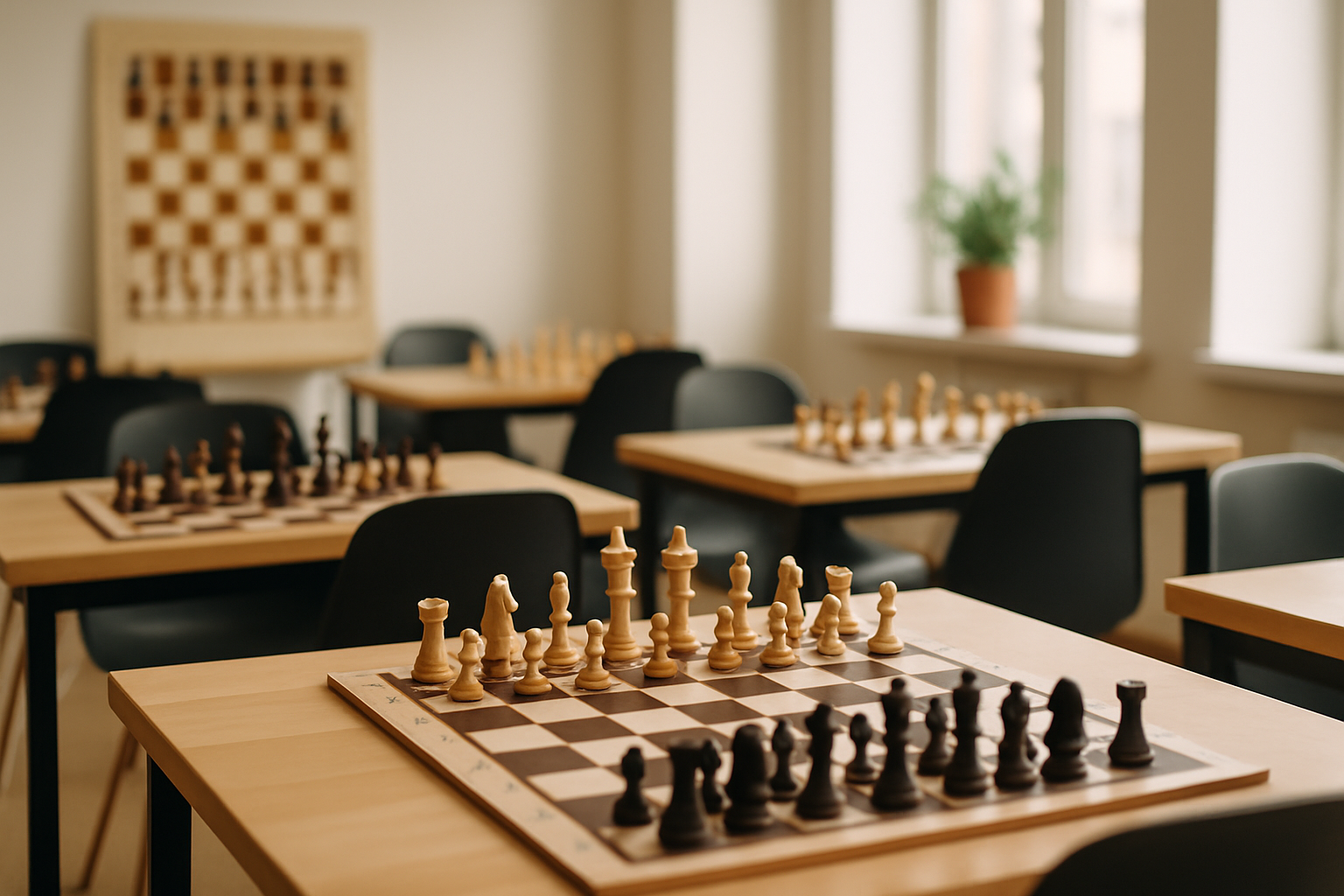
Rent a room, grab some boards, charge weekly — a chess academy's simpler than you'd think. Here's how to build one that actually pays.
Picture this: it's a Tuesday evening, a strip-mall classroom you're renting for three hours, eight kids hunched over boards, and their parents sitting in cars outside scrolling their phones — paying you every single week without complaint. That's a chess academy. No inventory to manage, no complicated supply chain, no product that expires. Just recurring sessions, engaged students, and parents who are genuinely grateful someone is teaching their kid to think.
The economics are surprisingly clean. A modest setup — shared space, home studio, a folding table and a stack of boards — runs somewhere between $3,000 and $8,000 to get off the ground. Go dedicated, with your own classroom and 10–15 boards permanently in place, and you're looking at $15,000–$25,000. Neither number is scary compared to most education businesses. And if you can fill two consistent batch groups (which is more achievable than it sounds), most operators are hitting break-even somewhere in the 6–10 month window.
This playbook covers four phases in sequence: getting the legal and structural foundations right, sorting your space and equipment, building a curriculum and pricing model that holds up, and actually landing your first 50 students. It also flags the specific mistakes that stall most new founders — because there are patterns, and they're avoidable.
Phase 1: Register the business and handle compliance
Most people starting a chess academy waste the first three months convinced they need some special educational licence. They don't. Chess academies sit in an odd middle zone — education-adjacent, yes, but almost never regulated the way schools are — which means the actual compliance burden is lighter than you'd expect. Sort the paperwork early, sort it properly, and it stops being a thing you think about.
Business structure
- Sole proprietorship — if you're starting solo and keeping it small, this is your fastest route. No real setup cost, you carry personal liability, and honestly it's fine for year one.
- LLC (US) / LLP or Ltd (UK, AU, CA) — the moment you bring on a second coach or sign a lease on a dedicated space, upgrade your structure. A single-member LLC in the US runs $50–$500 depending on which state you're in. In the UK, registering a private limited company at Companies House costs £50. That's it.
- Partnership or Pvt Ltd is the play if you're co-founding with someone. And here's the part people skip: get a shareholders' agreement signed before you open the doors. Verbal arrangements feel fine until money starts moving — then they fall apart every single time.
Tax registration
Nobody enjoys this part. But get it wrong and you're untangling a mess eighteen months from now — so here it is, country by country.
US: Grab your EIN first — it's free, takes ten minutes on IRS.gov, and you'll need it for basically everything else. Sales tax on coaching services? Mostly a non-issue. Most states don't tax in-person instruction. Digital course sales, though — that's a different story, and it varies by state, so check yours specifically.
UK: Sole trader? Register as self-employed with HMRC. Hiring staff from day one? You'll also need to register the company and set up PAYE. The VAT threshold sits at £90,000 turnover — and honestly, don't lose sleep over that in year one.
Germany and France (and several other EU countries) treat tutoring and coaching as VAT-exempt services — but "often exempt" isn't the same as "always exempt," and the rules shift enough between member states that a local accountant is worth the hour's fee to confirm.
Canada: GST/HST registration kicks in once you cross CAD $30,000 in revenue. Below that threshold, you're fine to hold off.
Trade license and premises permission
Get the trade licence sorted before you do anything else — the fee is dead simple, usually somewhere between $50 and $200 a year depending on where you're based. What it's actually called varies: a local business licence in the US, a premises licence elsewhere, a trade permit in some jurisdictions. Different names, same idea.
Running out of a commercial space? You'll need one. No question there.
Home-based is where it gets murkier. Most residential zones will let you run a small tutoring operation without any drama, but they'll put a hard cap on how many students can be on the premises at once. Check your local zoning rules before you book your first batch of kids — because that cap isn't a guideline, it's enforceable.
Child safety policy
Let's assume most of your students are under 18. That assumption is almost certainly correct.
Which means a written safeguarding policy isn't a nice-to-have — it's the baseline. In the US, any coach who's ever alone with minors needs a background check, typically run through Sterling or Checkr, plus a written code of conduct that everyone signs. UK academies should align with the NSPCC's safeguarding framework (it's not prescriptive, but it gives you solid ground to stand on). Australia's simpler in one sense: Working With Children checks are mandatory across every state, full stop.
Don't wait for someone to ask. They will ask — parents are far more likely to raise this now than they were five years ago, and if you're hoping to partner with schools, they'll want to see documentation before the conversation gets very far.
Get the policy in writing. Get it done early.
Insurance
Have you actually looked into what happens if a student trips over a bag and breaks their wrist in your academy? Because that's the conversation most new academy owners avoid until it's too late.
Public liability insurance is the non-negotiable baseline — it covers injury on your premises, and it's not as expensive as people assume. In the US, a small academy is looking at roughly $300–$600 a year. In the UK, £150–£300. That's it. Less than a decent chess set.
Selling coaching programmes or online courses? You'll want professional indemnity on top of that. It protects you if a client claims your advice caused them harm — financial, reputational, whatever. Sounds unlikely until it isn't.
And the moment you hire your first coach — your very first member of staff — employer's liability kicks in. In the UK, this isn't optional. It's legally mandatory from day one. Don't find this out the hard way.
Phase 2: Space, equipment, and setup costs
Walk into almost any chess academy and you'll notice what's not there — no sprung floors, no wall-to-wall mirrors, no PA system humming in the background. That's one of the genuinely pleasant surprises of this business. The physical setup is dead cheap compared to, say, a dance studio or a martial arts hall. What you're actually hunting for is a room that's quiet (harder to find than you'd think), has decent overhead lighting, and gives each student enough elbow room that they're not reading their opponent's expression from six inches away.
Space sizing
The mistake most new academy owners make? Signing a lease before they have students. Don't do that.
Here's what the numbers actually look like: you need roughly 15–20 sq ft per student once you account for the table, the chair, and enough elbow room that nobody's knocking pieces off their neighbour's board. A 10-board class works out to somewhere between 250 and 300 sq ft of usable floor space. That's not a warehouse — it's a large living room. It's the back room at your local library. It's a co-working space that rents by the hour.
Early on, you have three realistic options.
A home studio or garage conversion is dead simple if you can manage it — rent overhead is basically zero, and it handles groups up to 8 without feeling cramped. A community hall or library room is the next step up; most rent for $15–$40/hour, and if you're running three batches a week, your total space cost stays under $500/month. Both of these let you test whether demand is actually there before you commit to anything.
A dedicated leased space is a different beast entirely. It only makes sense once you've got 30+ regular students showing up consistently — and even then, run the numbers twice before you sign anything.
Equipment list
Here's what you actually need to buy. Not a wish list — a working inventory.
Tournament chess sets with weighted pieces run $20–$35 each. Get 12 to 15 to start — you don't want to be scrambling mid-session because two sets went missing. Roll-up vinyl boards ($8–$15 each) are the right call: they survive being stuffed into a bag fifty times and don't warp. Clocks — one per board, no exceptions for timed games — cost $25–$50 depending on whether you go analog or digital. The magnetic demonstration board (wall-mounted, $60–$150) isn't optional if you're doing group instruction; trying to explain a tactic without one is painful for everyone. Folding 4-ft tables at $40–$80 each, one per two students. Stackable chairs, $15–$30. A whiteboard or projector for showing digital positions ($80–$300). And a software licence — ChessBase, Chessable, something in that category — at $50–$200 a year for analysis and homework assignments.
What does that add up to?
- Lean setup (home or rented hall, 10 boards): $1,500–$3,500
- Mid-range dedicated space (15 boards, projector, decent furniture): $8,000–$15,000
- Full academy fit-out (20+ boards, reception area, coaching tech): $18,000–$28,000
You don't need to touch the flooring. But lighting — and this catches founders off guard more than anything else — actually matters. Cheap fluorescent strips will have your students squinting after an hour of a 90-minute session. If the space doesn't already have decent overhead lighting, put $150–$300 aside for proper LED panels. It's a small line item that makes a real difference.
Phase 3: Curriculum and pricing
What to teach first
Start with the basics. Seriously — before you even think about tournament prep or opening repertoires, you need a working beginner pipeline. That's where the bulk of your students will come from, and without it, the rest doesn't matter.
Here's how most academies sequence it:
- Absolute beginners (ages 5–8): Piece names, how each piece moves, and the two checkmates every new player should know — Scholar's Mate and back-rank. Run this as an 8–12 week module. Don't rush it.
- Intermediate juniors (ages 8–14): This is where tactics come in — pins, forks, skewers, discovered attacks. Opening principles (not memorised lines, not yet). Basic endgames. Kids at this stage are ready to start thinking, not just moving.
- Club-level players (rated or near-rated): Now you can get into opening repertoires, positional concepts, game analysis, and actual tournament preparation.
Levels 1 and 2 are where your student volume lives. That's not a guess — it's just numbers. Most people who walk into a chess academy are beginners or close to it, and if your programme isn't built to handle them well, you'll struggle to fill seats at any level.
Get those two levels running smoothly first. Level 3 can wait.
Batch structure
Six to ten students per batch. That's the number that actually works — below six and you're barely covering costs, above twelve and the session turns into crowd control. You simply can't give meaningful individual feedback during play when you've got fifteen kids moving pieces simultaneously.
Frequency depends on where your students are in their development. Beginners do fine at two sessions a week — more than that and there's nothing new to absorb yet. Intermediate students benefit from three. Serious competitors (the ones eyeing district or state tournaments) need four to five sessions weekly, and honestly, even that can feel insufficient come tournament season.
Session length is one of those things coaches routinely get wrong in the beginning. Under-10s lose focus past the 75-minute mark — and often well before that. Sixty to seventy-five minutes is your window. Older students can handle ninety minutes without the glazed-eye effect setting in.
Age grouping matters more than most people realise when they're starting out. Keep the spread within a batch to three or four years maximum. A 6-year-old and a 12-year-old are not just at different skill levels — they process instructions differently, they get frustrated differently, and they have completely different reasons for being in the room. Mixing them doesn't serve either.
Pricing
What should you actually charge? It's the question every new academy owner either obsesses over or completely avoids — and both extremes cost you money.
Here's where the market sits right now:
- Group class (2x/week, 8 students) — $80–$150/month
- Group class (3x/week, 6 students) — $130–$200/month
- Semi-private (3–4 students) — $200–$350/month
- Private 1:1 coaching — $40–$90/hour
- Online group class — $50–$100/month
- Holiday intensive (5-day camp) — $150–$300 per student
If you're operating in the UK, smaller cities typically run 20–30% below these figures. London and other major metros, though? They track pretty close to US pricing.
Now — the free trial question. You'll face this constantly, especially from cautious parents who want to "see if my child likes it first."
One free trial class works. One. Don't offer a whole free week. That's a trap — it conditions parents to expect discounts, and frankly, it draws in people who were never going to pay you anyway. Keep it to a single 45-minute session, charge half-rate or nothing at all, and then have the enrolment conversation while the parent is still sitting in front of you. Once they walk out the door, you've probably lost them.
Phase 4: First 50 students
Google Business Profile
Most academy founders waste their first month obsessing over a logo or a website colour scheme. Meanwhile, their Google Business Profile sits unclaimed — and that's the actual mistake.
Claim it first. Seriously, before you do almost anything else.
A complete GBP — real photos, your opening hours, a description that spells out which age groups you teach — is what gets you into those "chess classes near me" searches. That's where parents are already looking. You don't have to chase them; you just have to show up where they're searching.
Give it 4–6 weeks once the profile's properly filled out. It's free, it compounds, and nothing else on your early marketing list comes close to the return.
WhatsApp Business
WhatsApp Business takes about ten minutes to set up. Do it before you launch anything else.
Write a proper auto-reply — not the default placeholder text. Parents who message at 11pm aren't expecting an instant response, but they are expecting acknowledgment. A clean auto-reply that says when you'll get back to them (and ideally mentions a link to your schedule or fees) does a lot of quiet work for you.
Build a broadcast list for prospects early, even when it's just seven people. That list becomes genuinely valuable once you're announcing a new batch or filling seats after a dropout.
And here's the bit most academy founders in the US underestimate: outside America, WhatsApp isn't a secondary channel. In India, Southeast Asia, the UK, Australia — it's where parents actually live. Email is for receipts. WhatsApp is where decisions happen. Even in the US, if you're targeting families with young children, you'll find response rates on WhatsApp embarrass email by a wide margin. Don't wait until you've confirmed whether your market "uses WhatsApp." Set it up, put the number on everything, and let parents self-select.
School tie-ups
Here's something most new academy owners skip entirely: walking into a school and asking for five minutes of someone's time. Not to pitch a paid programme — not yet. Just to drop a flyer in the weekly newsletter, or offer a free 30-minute chess demo over lunch. That's it. That's the whole ask.
Target 5–10 local primary and middle schools. Walk in if you can — cold emails get buried, but a face at the front desk is harder to ignore. And when even one of those schools converts? Eight students from a single partnership pays for itself immediately, and the pipeline doesn't dry up — it refills every academic year, automatically, as new batches come through.
Don't overthink the entry point. The demo isn't the product. It's just the door.
Instagram Reels strategy
Film a 30-second "spot the checkmate in 2 moves" Reel. Do it twice a week. That's the whole strategy — don't make it more complicated than that.
Phone camera. Clean board. Decent lighting. You don't need a ring light setup or a cinematographer; you need consistency. Eight weeks of posting before you even think about whether it's working — because it won't look like it's working at first, and that's fine.
The reason this format spreads is that chess is one of those rare subjects where the content itself is the hook. Parents share these with other parents. Chess communities pass them around. A puzzle Reel gets far more organic reach than anything that looks even slightly like an ad — and most promotional content, however well-intentioned, looks exactly like an ad.
So resist the urge to polish. Resist the urge to add a voiceover explaining your academy's philosophy. Post the puzzle, let people argue about the answer in the comments, and do it again Thursday.
Festival-season acquisition
Parents are basically primed during those back-to-school weeks — August through September in the US, September in the UK — in a way they simply aren't at other times of year. There's something about buying new stationery and school shoes that puts them in a "yes, let's add a structured activity" headspace. Don't waste it. Run a focused three-week enrollment push before school starts: a modest early-enrollment discount, a social media blitz, and one parent info evening where they can ask questions and actually see the space.
December camps are a different beast, and honestly one of the most underrated tools for building a stable student base. A five-day holiday intensive isn't just a revenue line — it's a conversion engine. Kids who come in for the camp, enjoy it, and leave with a rating or a new opening they're proud of? They sign up for regular batches at a rate that almost nothing else matches. The format does the selling for you.
Managing from day one
At what point does running your academy start feeling like a second job? For most coaches, that answer is somewhere around 20–30 students spread across multiple batches — which is exactly when the spreadsheet you've been nursing starts to fall apart. Attendance? Tracked in one place. Fees? Chased through WhatsApp. Batch reminders? Sent manually, half the time late.
You don't want to be doing that. Get a class management tool in place before you actually need it — not after. Something that handles scheduling, fee collection, automated reminders, and parent communication without you touching each one individually. The 10 Steps To Starting Your Own Dance Studio playbook has a solid breakdown of software stack decisions that translate surprisingly well to a chess setup — worth a look when you're weighing your options.
The administrative drag is real, and it compounds. Sort it early.
Common mistakes new founders make
Picture this: someone opens a chess academy with six time slots on launch day, posts about it everywhere, and then spends the next three months coaching ghosts. Empty chairs. Overhead ticking. It's a more common story than you'd think, and it's almost always avoidable.
1. Too many batches, too soon. Start with one or two. Fill those. Then expand. That's it. Founders who do the reverse — flooding the schedule before a single student has paid — burn through runway fast and lose confidence faster.
2. Underpricing to "attract" students. Here's what actually happens when you charge $40/month: parents assume it's a hobby group. Not a structured programme. Underpricing doesn't signal accessibility — it signals doubt about your own product. Price at market rate from day one. Discounts are easy to give; raising prices on students who've already enrolled is a much uglier conversation.
3. Skipping safeguarding because the paperwork feels pointless. It isn't. Schools won't touch you without a policy in place, and parents — particularly the ones who do their research — are starting to ask for it upfront. Two hours. That's how long a basic safeguarding policy takes to write. Do it before your first student walks in, not after someone asks.
4. Buying equipment before you have students. Don't spend $2,000 on boards and clocks when you haven't confirmed ten enrolments yet. Borrow six to eight sets, run your first trial batch, see if the format actually works — and then invest in full inventory once you've got proof of concept. The boards will still be there.
5. Building entirely around tournament players. Competitive students are a small slice of the market. A small, high-maintenance, seasonally distracted slice. The bigger and more stable revenue is sitting in casual learners, adult beginners, school partnership programmes, and corporate team-building workshops. A curriculum that only serves tournament hopefuls is a curriculum with a ceiling. Build wider.
6. No follow-up system after trial classes. Most founders hand a kid a trial session, say "let us know!" and wait. That isn't a sales process — it's a hope. What actually works: a message the same evening, a specific question about what the student enjoyed, and a clear enrolment offer within 48 hours. The window closes fast. Use it.
7. Treating online as a lesser option — or ignoring it entirely. A hybrid model (two in-person sessions plus one online per week) doesn't just help students who are travelling or unwell stay consistent. It expands your geographic reach in a way no local flyer campaign ever will. Chess is genuinely well-suited to this — the board is dead simple to share on screen, and the game loses nothing in translation. That's an advantage. Use it.
Regional notes — US / UK / EU / India
United States
No special licence. That's the honest answer for most states — you don't need one to run a tutoring or coaching business.
Incorporation is a different story. Delaware and Wyoming LLCs come up constantly because the fees are low, but if you're actually operating locally, register in your home state. Saves you the hassle of maintaining a foreign entity for no real benefit.
Background checks for coaches working with minors — this is where it gets state-specific, and you can't afford to guess. California, New York, and Texas each have their own requirements (they're not interchangeable). Pull up your state's department of education guidelines and read them directly. Don't rely on secondhand summaries.
United Kingdom
Here's something most new academy owners in the UK don't realise until a school turns them away: it's not the ECF membership that opens doors — it's the NSPCC safeguarding certificate. The ECF affiliation is genuinely useful (it lends credibility, and serious club players will notice), but it's not compulsory. The safeguarding cert, though? That's what headteachers and parents actually ask to see before they let you anywhere near their kids.
On the business side, registering as a limited company through Companies House is dead simple — online, done in 24 hours, and cheaper than you'd expect. No reason to drag your feet on that one.
European Union
Register for the OSS scheme if you're taking students across EU borders digitally — it collapses what would otherwise be a nightmare of country-by-country VAT filings into a single return. Do that first, before the admin chaos catches up with you.
On VAT itself: it's not uniform across the bloc. France and Germany generally treat coaching and tutoring as exempt educational services. The Netherlands doesn't — they tax them. So the country your student sits in when they log on to your session can actually change your tax position. Worth knowing before you price your subscriptions.
GDPR is non-negotiable. The moment you collect a parent's email address — or a child's name, or literally anything that identifies a person — you're in GDPR territory. Get a basic privacy policy live on your site before that first signup form goes up. Not after. Before.
India
— and this is where a lot of new academy owners get caught off guard. Chess coaching doesn't sit neatly inside India's education framework. It's not regulated the way a school is. But the tax authorities have an opinion about it: once you cross ₹20 lakh in annual revenue, GST kicks in at 18% on your coaching fees. That's not optional, and it catches people late.
If you're teaching children — which, let's be honest, most of you are — POCSO-aligned safeguarding policies aren't a box-ticking exercise. They're non-negotiable. Full stop.
Now, AICF affiliation. You don't technically need it to open your doors and start charging fees. But try getting your students into rated tournaments without it, or try explaining to a serious chess parent why your academy isn't affiliated with the All India Chess Federation. The credibility gap shows up fast.
Pricing varies more than people expect. Group classes in smaller cities can sit around ₹1,500/month; the same batch structure in a Mumbai or Bengaluru metro often fetches ₹4,000/month or more. Batch size matters too — twelve to fifteen boards is a reasonable target for a working classroom, and fitting out that kind of dedicated space in a metro will run you somewhere between ₹3 lakh on the lean end and ₹8 lakh if you're doing it properly.
The operational reality is messier than the numbers suggest. Most academies start in borrowed rooms before any of this becomes relevant.
Frequently Asked Questions
How much does it cost to start a chess academy?
Picture this: you've got a folding table, two chairs, a clock, and a board. That's a chess academy. Seriously — the barrier to entry here is lower than most people assume, and if you're working out of a rented room or your own home, you're looking at somewhere between $1,500 and $3,500 to cover equipment and those first few operating costs. That's it.
Scale up, though, and the numbers change fast.
A proper dedicated space — leased premises, actual furniture, coaching tech like demo boards or digital displays — you're probably spending $15,000 to $25,000 before a single student walks through the door and pays you anything. That's not a warning, just something to plan around.
Do I need a chess rating or FIDE title to run a chess academy?
Here's the mistake most people make before they even get started: they assume they need a FIDE title — an FM, an IM, something official — before they're "allowed" to run an academy. They don't. In most jurisdictions, there's no formal credential required to operate one. Full stop.
That said, having a FIDE rating or a membership with your national federation (US Chess, ECF, whatever applies to you) does real, practical work. Schools want to see something on paper before they'll let you near their students. A rating gives them that. It's not a legal requirement — it's a trust shortcut.
Most successful academy founders aren't titled professionals. They're strong club players who understood their local market, built relationships, and showed up consistently. The title helps. It's not the point.
What age group should I target first?
Start with 6–12 year olds. That's the honest answer. This age bracket fills seats, shows up consistently, and — crucially — comes with parents who already have a reason to pay: they want sharper focus, better grades, a kid who can sit still and think. The motivation is built in. You don't have to manufacture it.
Attendance patterns tell the same story every time. Younger students, especially in the 8–11 range, are creatures of habit. If chess is on Tuesday at 4pm, they're there. Adults cancel. Teenagers ghost you. Six-to-twelve year olds just show up.
Build your curriculum here first. Get your beginner-to-intermediate pathway solid, your parent communication tight, your batch sizes figured out. Adult programmes and advanced coaching can come later — and they will, once word spreads — but trying to serve everyone on day one is how academies stall before they ever find their footing.
How do I handle students at very different skill levels in one batch?
Here's something nobody warns you about when you're setting up batches: age gets you only so far. Two ten-year-olds can be a full year of serious training apart in actual ability, and you'll figure that out fast once you're standing in front of them.
The fix that actually works in practice is a split-session structure. Open with 20–25 minutes of whole-group instruction — pick one shared topic, a tactics motif, an endgame pattern, something everyone in the room can engage with at their own depth. Then use the remaining time differently for different students. Stronger kids play each other under supervision. Beginners get the one-on-one attention they genuinely need and, honestly, won't get if you're trying to run a single activity for the whole group.
It's not perfect. But it's workable — and in a mixed-level batch, workable is what you're aiming for.
Should I offer online classes from the start?
Start one online batch. Just one — four to six students is enough. You don't need to overhaul your entire programme or buy special equipment. Run it alongside your in-person classes, see how the format feels, and figure out what you're bad at before you scale it up.
The reason to do this early isn't ambition. It's economics. An online batch costs you nothing in rent or space — the margin on those sessions is essentially clean revenue. Chess.com's game rooms and Lichess both handle group sessions without much fuss, so the technical barrier is genuinely low.
Most mid-sized academies end up running a hybrid model by year two anyway: mostly in-person, one or two online batches on the side. Starting that online batch in year one just means you've already worked out the k