Equipment Checklist for a New Yoga Studio (2026)
By Swathi N ·
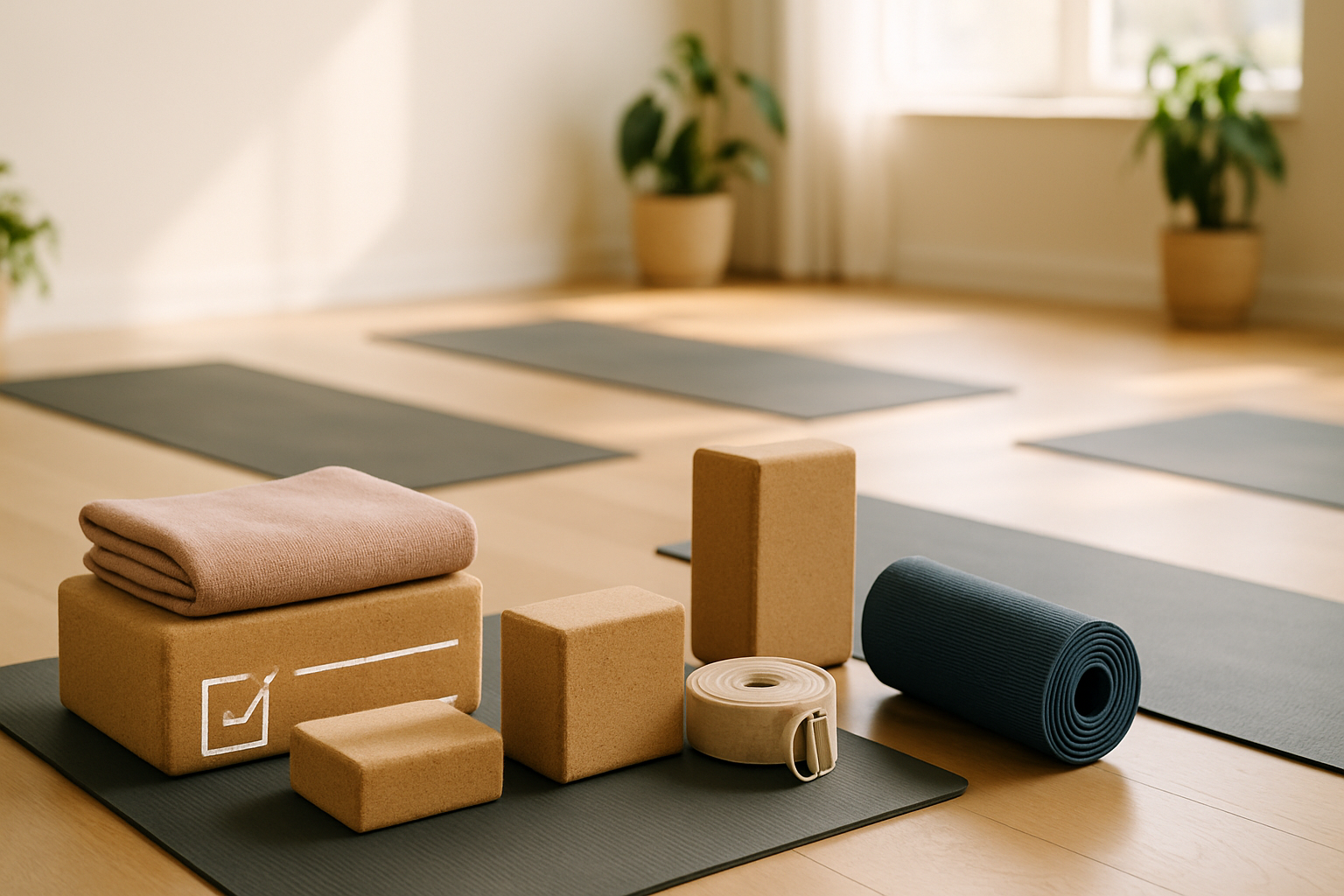
Outfitting a new yoga studio in 2026? Here's the exact gear that matters — and what a ₹1.2–2.5 lakh budget actually gets you.
Picture this: it's your first real class, ten students lined up, and someone — always someone — glances down at the mat under their feet and then back up at you. That moment happens. And in 2026, with boutique studios everywhere stocking Liforme mats and cork blocks as standard, students walk in already knowing what good looks like. They'll notice the shortcuts before you even finish your opening sequence.
So budget accordingly. Outfitting a new studio with the ten things you actually need runs somewhere between $1,500–$3,000 (roughly ₹1.2–2.5 lakh), and that spend breaks down across three buckets: floor and practice gear, props and alignment aids, and studio infrastructure. Not glamorous categories, but get them right and the rest follows.
The 10 Essentials
1. Yoga Mats (class set of 10–15)
Buy the mats before you buy anything else. Seriously — this is non-negotiable.
Most of your students won't bring their own mat for the first few weeks, maybe longer. Drop-ins definitely won't. And the moment someone slips on a thin, worn-out mat during their very first class, that's the story they're telling their friends. You need a full class set of 10–15, and they need to actually be good.
Budget: $300–$600 (USD) or ₹25,000–₹50,000 (INR) for a set of 15. Mid-range, not bargain bin.
Liforme Travel Mats have a loyal following, but buying 15 of them will hurt. For a new studio watching cash flow, Manduka PRO Lite and Gaiam Studio Select are the smarter call — 4–5mm thickness, grip that doesn't quit after a few dozen classes, and pricing that doesn't make your accountant cry. As of May 2026, Manduka bulk orders (10 units or more) typically come with a small discount, so it's worth asking your supplier directly rather than just hitting checkout online.
The math is straightforward: cheap mats get replaced constantly, mid-tier mats last years under daily studio use. Spend the money once.
2. Yoga Blocks (foam, set of 20–30)
Honestly, if you're only going to stock one prop before opening day, make it blocks. Not bolsters, not straps — blocks. They show up in virtually every class format you'll run: Iyengar, restorative, vinyasa, you name it. And running out mid-session because you bought 12 for a 20-person class? That's the kind of thing students remember.
Aim for 20–30 foam blocks. Budget around $80–$160 (USD) or ₹6,500–₹13,000 (INR) for a set of 30 — which sounds like a lot until you're watching half your class wobble through Trikonasana with nothing to reach for.
For mid-tier options that actually hold up, Hugger Mugger foam blocks and BalanceFrom high-density foam blocks are both worth the money. Cork blocks are tempting — they photograph beautifully, students love them — but they'll run you 2–3x the cost. Leave those for a phase-two upgrade once you've got cash flow sorted.
3. Yoga Straps / Belts (set of 15)
Get 15 straps. Cotton, 6-foot length, metal D-ring buckle — not plastic, which cracks within months of regular classroom use.
The Manduka Align Yoga Strap and the Gaiam Yoga Strap are both solid picks here. As of May 2026, packs of 10 are easy to find on Amazon US and Amazon India, so stocking up isn't a headache.
Cost: $45–$90 (USD) / ₹3,500–₹7,500 (INR) for a set of 15.
And here's why you actually need them: straps do the heavy lifting (so to speak) for students who can't yet reach their toes, for restorative sequences, and for any flexibility work where pulling joints into awkward positions would be the alternative. They're light, they're cheap, they last years without any real maintenance. There's genuinely no argument for leaving them off the list.
4. Bolsters (set of 6–8)
Why it matters: If you plan to offer restorative or yin classes at all, bolsters are non-negotiable. They're also the item students are least likely to bring from home. Heavy, so budget for shipping if ordering online.
Cost range: $150–$300 (USD) / ₹12,000–₹25,000 (INR) for 8 bolsters
Brand recommendation: Halfmoon Rectangular Bolster and Hugger Mugger Standard Bolster are both mid-tier picks with removable, washable covers — important when multiple students use them daily.
5. Blankets (set of 10)
Already wondering if blankets are really worth a dedicated line item? They are. Genuinely one of those things you'll regret skimping on.
Students use them constantly — tucked under the hips in seated forward folds, rolled beneath the knees in supine poses, draped across the body during savasana when the temperature drops and everyone suddenly wants something warm. A set of 10 gets you through a full beginner class without hunting around.
The material matters more than the brand. Aim for at least 70% wool or a heavy cotton blend — synthetic blankets sound fine in theory, but they compress under body weight, lose their shape fast, and end up looking shabby within a year. Thick Mexican-style yoga blankets are the benchmark here. They're dense, they hold their fold, and they last years longer than the thinner alternatives.
What to buy: Hugger Mugger Traditional Yoga Blanket if you want a reliable branded option. For a more budget-conscious route, unbranded Mexican-style blankets sourced through wholesale suppliers work just as well — Amazon India and IndiaMART both have reasonable options if you're buying in bulk.
Cost: $100–$200 (USD) / ₹8,000–₹16,000 (INR) for a set of 10.
6. Non-Slip Studio Flooring
Picture this: someone's mid-Warrior II, weight shifted, arms extended — and their back foot slides three inches on polished tile. That's not a comfort issue. That's a liability issue, and it happens on opening week if the flooring isn't sorted.
Hardwood and bamboo are the gold standard here, no question. But if you're working with existing concrete or tile (which most converted spaces are), you need either a full-room rubber underlayer or interlocking foam floor tiles — not just a few mats scattered around. The whole floor has to be addressed.
Budget somewhere between $300–$600 USD (₹25,000–₹50,000 INR) for a 500–800 sq ft space. That's actually one of the more reasonable line items in a full studio fit-out.
For product options: IncStores Yoga Gym Rubber Floor Tiles in the US, or Decathlon rubber gym flooring tiles at any Decathlon India location. As of May 2026, both come in interlocking formats — no adhesive, no contractor, and you can reconfigure the layout later if you need to.
7. Sound System
The single biggest mistake new studio owners make? Grabbing a Bluetooth speaker, setting it on a shelf, and calling it done. For a 600 sq ft room running 45–75 minutes of continuous music per class, that's not a sound system — it's an embarrassment waiting to happen.
Here's what actually works: the JBL EON One Compact or the Bose S1 Pro. Both are portable, both connect via Bluetooth or aux, and neither distorts when you push the volume up to fill a room properly. That last part matters more than people realise — tinny, crackling audio at medium volume is somehow worse than silence.
Budget: $150–$350 (USD) / ₹12,000–₹28,000 (INR) for either of those. If your space runs above 800 sq ft, though, stop looking at portable speakers entirely. You'll need a ceiling-mount setup, and yes, it costs more — but a ceiling-mount in a larger room sounds like a professional studio, and a Bose on a stool sounds like a pop-up event.
8. Mirror Wall (or Large Wall Mirror Panels)
Mirrors do two things at once: they let students fix their own alignment without you calling it out every thirty seconds, and they make a cramped studio feel almost twice as big. That's a hard combination to argue against.
That said — not every style wants them. Mysore Ashtanga studios skip mirrors deliberately, and a few other traditions follow suit. But for most formats? Put them up.
Cost: $200–$500 (USD) / ₹16,000–₹40,000 (INR), depending on how much wall you're covering.
There's no dominant brand in this category. Most studios just call a local glass supplier — or in the US, walk into a Home Depot; in India, go through a Saint-Gobain glazier. The glass itself is cheap. Installation is where it gets expensive, because hanging large mirror panels safely isn't a two-person weekend job. Budget for that separately, upfront, before you're surprised by the labour quote.
9. Storage Shelving and Mat Racks
Why it matters: Mats, blocks, bolsters, and blankets piled in a corner make even a nice studio look chaotic. Vertical mat racks free floor space and signal organisation to students.
Cost range: $100–$200 (USD) / ₹8,000–₹16,000 (INR)
Brand recommendation: Athletico Yoga Mat Storage Rack (holds 10–12 mats) is a practical mid-tier pick. For props and blankets, open-shelf storage units from IKEA or local carpentry work fine — no specialty brand needed.
10. Air Conditioning / Ventilation System
Get the ventilation sorted before you book your first class. Seriously — this is the one item that almost every new studio owner underestimates, and it's the one that bites hardest once students are actually in the room.
Ten bodies in a sealed space generate a surprising amount of heat. Even a standard flow class (not hot yoga — just regular vinyasa) turns a poorly ventilated room stuffy within twenty minutes. For any hot yoga variant, inadequate airflow doesn't just mean discomfort. It becomes a genuine safety concern.
A split-unit AC plus basic ventilation will run you $400–$800 USD (roughly ₹32,000–₹65,000 INR) for a mid-sized room. Daikin and Mitsubishi Electric are the workhorses here — both handle daily commercial use without drama, and both have decent service networks if something goes wrong. Throw in a ceiling fan as a backup. It's another $50–$100 and it earns its keep on days when the AC is struggling or the unit needs servicing.
Don't treat this as optional infrastructure you'll "sort out later." Studios that launch without it spend the first three months fielding complaints and losing early members who simply don't come back.
Related reading: Setting up a general fitness space alongside your yoga studio? The Equipment Checklist for a New Gym & Fitness Studio (2026) covers weights, cardio gear, and functional training equipment.
Recommended Add-Ons
And honestly, these are the things that separate a studio that feels considered from one that just feels functional.
Eye pillows — get a set of 10–12. Students who've never used one in savasana will use one once and never want to go without. They're dead simple to sanitise between classes, and a full set runs somewhere between $40–$80 (₹3,000–₹6,500). The cost-to-impact ratio here is ridiculous.
Sandbags are a different story — not everyone needs them on day one, but if you're running restorative or yin formats, you'll feel their absence fast. Hip openers, shoulder work, anything where sustained passive weight helps: sandbags do the job that a folded blanket almost does but doesn't quite. A set of 6–8 costs $80–$150 / ₹6,500–₹12,000.
Meditation cushions (zafus, specifically) matter more than people expect. If you're ending strong vinyasa classes with extended seated work — or running dedicated meditation sessions — asking students to sit on a mat for 15 minutes is asking a lot of their hips. A set of 8–10 runs $100–$200 / ₹8,000–₹16,000, and it signals that you've thought about the full arc of a class, not just the movement portion.
Put a whiteboard near your entrance. Magnetic, simple, nothing fancy. Sub-teacher notices, the week's schedule, upcoming workshop announcements — students check it every single visit without being asked to. It's the kind of low-tech thing that actually gets used.
Scent is underrated. A couple of ultrasonic diffusers running lavender or eucalyptus during class ($30–$60 each) sounds minor, but it shows up in studio reviews with a frequency that will genuinely surprise you. Atmosphere isn't just lighting and music — smell is doing quiet work the whole time.
For check-ins, you don't need a full front-desk setup to look like you have one. A second-hand iPad on a stand, running your studio management software, handles waivers, class check-ins, and payments without breaking a sweat. Around $200 for the tablet and stand. That's it.
Optional Gear by Studio Style
Iyengar-Focused Studios
Walk into a well-equipped Iyengar studio and your first thought is probably: what is all this stuff? Wall ropes strung from cleats, wooden chairs lined up against the back wall, trestles that look like they belong in a gymnasium. It's a lot — and it costs accordingly.
The wall ropes (sometimes called yoga kurunta) are the centrepiece. These aren't DIY installations; they're custom rope systems mounted to proper wall cleats, and you're looking at $400–$900 installed. Don't cut corners here — the whole point is that students hang their bodyweight from them.
Beyond the ropes, you'll need wooden blocks alongside your foam ones (wood is non-negotiable in Iyengar work), backless folding chairs for inversions and backbends, and — if your teacher holds a higher-level certification — horse or trestle equipment as well. That last category gets expensive fast.
No other yoga format comes close to this prop budget. It's just the nature of the practice.
Hot Yoga Studios
The biggest mistake new hot yoga studio owners make? Pouring money into décor before sorting the heating system. A radiant heating setup — or an HVAC unit actually capable of holding 95–105°F (35–40°C) — runs anywhere from $3,000 to $8,000 depending on how large your hot room is. That's completely separate from your general equipment budget, and it's not negotiable.
Once the heat's handled, the next thing that'll bite you is ventilation. Heavy-duty fans aren't optional in a room where fifteen people are sweating through a 60-minute session — the air quality deteriorates fast without them. Floor drainage is worth building in if your space can accommodate it (retrofitting it later is expensive and messy). And don't fixate on temperature alone: humidity control matters just as much, sometimes more.
You'll also need sweat-absorbent mat towels for every student on the floor. Either stock them yourself or sell them at the desk — but don't assume students will bring their own, because they won't, especially beginners who don't yet know what they're walking into.
Restorative / Yin Yoga Studios
Restorative classes chew through props at a rate that'll catch you off guard if you've only ever stocked for vinyasa. Double your bolsters and blankets. Seriously — what looks like excess on a Tuesday will be exactly enough on a Friday evening class.
Yoga wheels are worth having: budget $20–$35 per wheel and pick up 8–10 of them. They earn their shelf space in yin sequences far more than most studios expect.
Two things people forget when fitting out a restorative room: lighting and sound. A dimmer switch isn't optional here — some sequences genuinely want near-dark, and overhead fluorescents will kill the mood faster than anything else you could do wrong. Pair that with a decent Bluetooth speaker that has a sleep timer built in, because nobody wants the music cutting out mid-hold or running indefinitely after a 10-minute savasana.
Where to Buy by Region
United States
- Amazon US — if you're placing a bulk order (blocks, straps, blankets — anything you need 20 or more of), this is where you start. Prime shipping is actually worth it at that volume.
- REI — don't sleep on this one for mats. Mid-range to premium stock, and the physical stores let you handle things before committing to a class set. That matters more than people admit.
- YogaDirect — an online specialist built specifically for studio buying. Wholesale pricing on blocks, straps, and bolsters; the whole model is geared toward volume purchases rather than individual shoppers.
United Kingdom
- Amazon UK — honestly, it'll cover most of what you need to get started. Manduka, Liforme, Hugger Mugger — all listed there, and usually with decent delivery times.
- Sweatband.com — worth bookmarking if you're kitting out a full space. Solid range of mats and props, and they occasionally run studio bundle discounts that can save you a fair bit.
Europe (EU)
- Amazon DE — if you're sourcing for mainland Europe, this is still the widest net you can cast. Selection is hard to beat.
- Decathlon EU — their own-brand Domyos line is honestly better than the price suggests. Blocks, straps, mats — when you're buying in volume, this is where the budget actually holds up without the quality falling apart on you.
India
Walk into any mid-budget yoga studio that opened in the last three years across Mumbai, Pune, or Bengaluru — there's a decent chance the blocks stacked in the corner came from Decathlon. It's the obvious first stop, and honestly, for good reason. Blocks, straps, mats, foam flooring tiles — they stock the full range, the prices are reasonable, and you can actually handle the products before committing to a bulk order. That last part matters more than people realise.
Amazon India is worth a look too, particularly for branded mats and bolsters. But be careful. Seller ratings here aren't just a formality — prop quality on the platform is genuinely inconsistent, and a four-star average can hide a lot of variance. Read the recent reviews, not the overall score.
For serious studio-grade stock at wholesale rates, two suppliers keep coming up: Shakti Yoga in Ahmedabad and Bharat Ek Khoj out of Mumbai. Both are findable on IndiaMART. Neither has the slick website of an international retailer, but that's not the point — the point is durability and price, and they deliver on both.
Then there's the custom route, which is genuinely underused. Tailors in Jaipur and Surat will make bolsters and prop covers to your exact specifications — fabric, density, dimensions, the lot — at a fraction of what you'd pay importing equivalent pieces. If your studio has a specific aesthetic or needs props sized differently from the standard, this is how you get there without blowing the budget.
Mistakes New Studios Make
The single most expensive mistake? Cheap mats. Not cheap-looking — actually cheap. Those no-name ₹600 mats feel perfectly fine when you unroll them the first time, but eight weeks of daily classes and they're peeling, sliding, and getting thrown out. You end up spending more than if you'd bought decent ones to begin with. Mid-range mats — somewhere in the ₹2,000–₹3,500 bracket for a class set — will last two to three years if you clean them properly. The economics aren't complicated.
Flooring gets treated like a "we'll sort it eventually" problem, and it almost always bites back. Studio owners happily spend on paint, a nice sign out front, some plants — the things people notice on Instagram. And then they lay a rug over hard concrete and call it done. That's a safety issue, not just an aesthetic one. Slippery or uneven surfaces and yoga do not mix. Get the flooring right before you open; it's also significantly cheaper to install when the space is empty.
Here's a props mistake that's almost universal with new studios: massively overbuying before you know what your classes actually need. Six students don't need twenty-five bolsters. They don't. Buy for your current headcount plus roughly 30% buffer, then scale up as you fill the room. Props don't go bad sitting in a cupboard, sure — but burning through your cash reserves in month two to stock a storage room you don't need yet is just bad maths.
Sound gets ignored until about four days before opening, and then it's a scramble. The result — and this happens constantly — is a first class where the instructor's phone is balanced against a water bottle, tinny audio barely reaching the back row. Word gets around. A room-fill speaker isn't a luxury; it's a day-one purchase, full stop.
And then there are installation costs, which almost nobody budgets for properly. Mirror panels, wall ropes if you're running Iyengar, AC units, even heavy shelving — none of that just appears on a wall. Labour costs money. Fixings, drilling, specialist fittings — it adds up fast, and it's never in the product price listed online. New studio budgets routinely run 20–30% over projection for exactly this reason. The hardware looked affordable. The installation was an afterthought. Don't let it be.
Frequently Asked Questions
How many mats does a new yoga studio actually need?
Here's something that catches new studio owners off guard: you'll almost certainly need more mats than you think. The base rule is simple — match your maximum class size, then add two or three on top of that. Running 12-person classes? Stock 15 mats. Drop-in students forget theirs all the time, and first-timers showing up to try a class aren't going to arrive with equipment. Running short on day one isn't a disaster, exactly, but it's an entirely avoidable headache — and the kind that makes a bad first impression you didn't need to make.
Is it worth buying premium mats (Liforme, Manduka PRO) for a class set?
Get mid-tier mats for your class set. Full stop.
Something like the Manduka PRO Lite (not the PRO) or Gaiam's studio line — those hold up fine under daily use, clean easily, and come in at roughly half the price of the premium options. When you've got fifteen students borrowing and sweating on the same mat every single day, a Liforme or a full Manduka PRO is genuinely hard to justify. The economics just don't work.
Where it does make sense to spend up? Your personal teaching mat. That one's yours, it gets consistent use, and you'll actually feel the difference. Class sets are a different beast entirely.
Do I need studio management software before I open?
Short answer: no. Not on day one, anyway. But give it a month — once classes are actually running, you'll feel the exact moment spreadsheets stop being enough. Bookings coming in, waivers to track, payments to chase, attendance to log. It compounds fast.
Start lean if you need to. A free fee invoice generator will handle early billing without any setup headache, and if you're planning workshops or a teacher training programme down the line, a free certificate generator is genuinely useful — more than most people expect. Then, when the volume justifies it, proper studio software brings everything into one place: class scheduling, automated reminders, membership management, the works.
The studios that struggle most with admin? They waited too long to switch.
> Want to run your studio without drowning in admin? Start your free trial of Lynk — built specifically for yoga and fitness studios managing bookings, payments, and student records in one place.