Equipment Checklist for a New Martial Arts Studio (2026)
By Swathi N ·
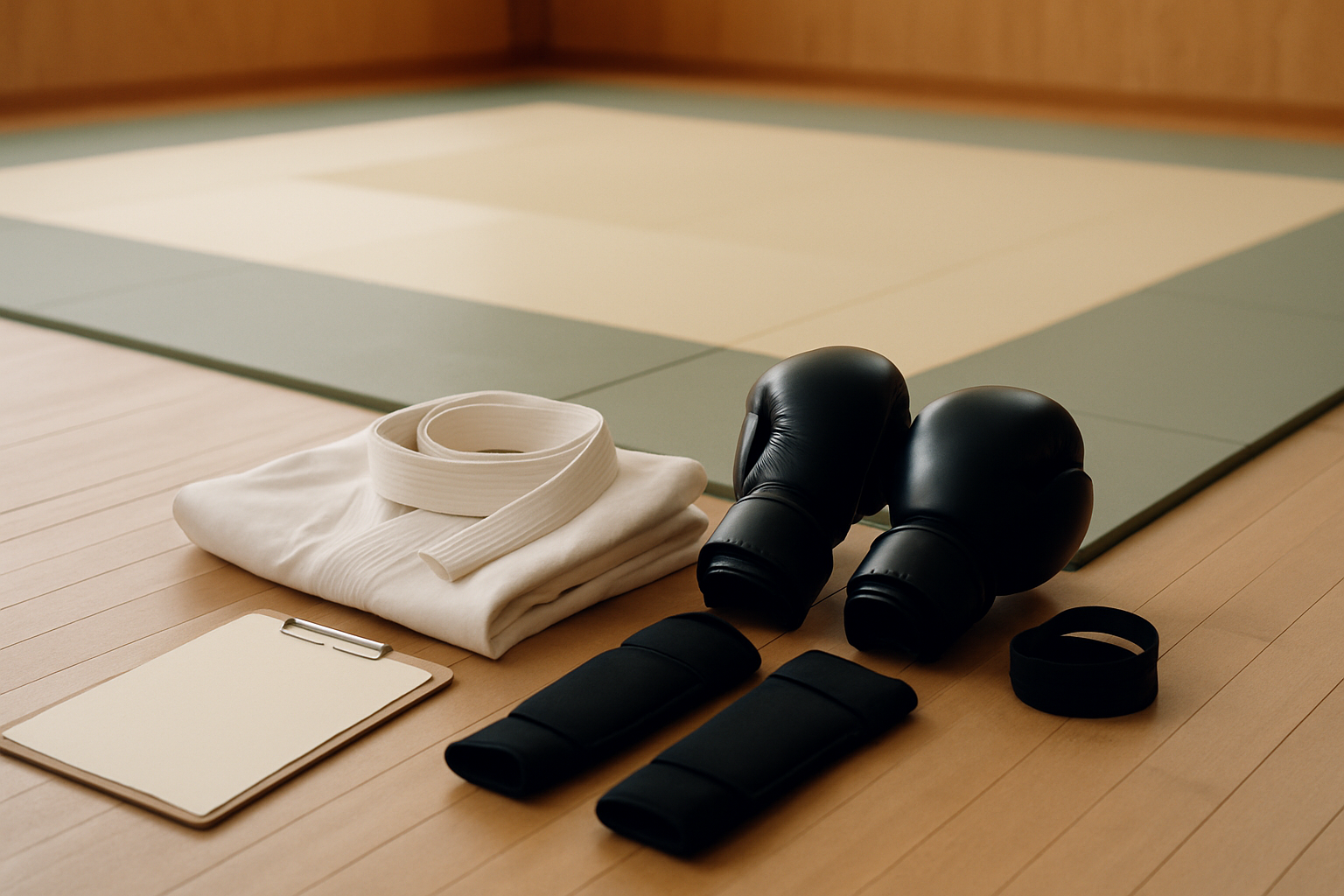
Starting a martial arts studio in 2026? Here's what you actually need first — flooring, striking gear, and admin tools — without blowing your entire budget u...
Walk into a studio that isn't ready and you know it immediately — bare concrete, a lone punching bag hanging from god-knows-what, maybe a hand-painted sign that's already peeling. Students notice this stuff. They walk in, take one look, and decide whether this place is serious before you've said a word.
Getting it right in 2026 costs money, but probably less than you're dreading. Most new studios put together a functional core setup somewhere in the $1,500–$3,000 range (call it ₹1.25–2.5 lakh if you're budgeting in rupees). That covers the three things that actually matter upfront: flooring and safety, striking and training equipment, and the studio management and administrative gear that keeps the place running once students start showing up.
Don't try to buy everything at once. Start with what protects your students, then what trains them, then what organises you.
The 10 Essentials
1. Interlocking Foam Mats / Tatami Tiles
Get this wrong and everything else suffers. Flooring isn't glamorous, but it's the one thing that will injure your students if you cut corners — twisted ankles, bad falls, the kind of knee trauma that sends someone home and never back. And students clock it immediately. Walk into a studio with cheap, thin mats and you've already lost credibility before the first class starts.
You're looking at $400–$900 (roughly ₹33,000–75,000) depending on how much floor you're covering and what density you go with. Not nothing, but not the place to economise either.
For actual brand options: Greatmats and Tatami Mall are both worth looking at. As of May 2026, both carry 1-inch to 2-inch EVA foam tiles that hold up under daily use without compressing into uselessness after six months. Greatmats' reversible 2x2 ft tiles in particular have become a go-to for MMA and grappling rooms — mid-tier pricing, decent durability, and they don't shift around under heavy sparring.
2. Heavy Punching Bag (Hanging or Freestanding)
Here's something no one tells you when you're outfitting your first studio: you can have the best mats, the nicest mirrors, a sound system that thumps — and students will still stand around looking restless until there's something to hit. That's the heavy bag. It's not glamorous, but it earns its floor space every single session.
Muay Thai, boxing, karate fundamentals — doesn't matter what you're teaching. Striking drills need a target, and conditioning rounds need resistance. A bag handles both.
Cost: $80–$250 (roughly ₹6,500–21,000), which puts it well within reach even for a shoestring opening budget.
For brands, Everlast and RDX are both solid mid-tier choices. Neither will embarrass you. If your space doesn't have ceiling mounts — and plenty of studios don't, especially if you're renting — the Everlast 70 lb Powercore freestanding bag is the one to look at. It moves a bit more than a hanging bag on hard shots (that's just physics), but it's practical and doesn't require you to drill into a landlord's ceiling. For hanging bags, 70–100 lb is the sweet spot for adult beginners through intermediates. Anything lighter and your stronger students will be swinging it like a pendulum within a month.
3. Focus Mitts and Thai Pads
Get at least four to six pairs before you open — ideally six. Anything fewer and you've got half your class standing around doing nothing while two people hog the pads.
Focus mitts and Thai pads are where technique actually gets drilled into muscle memory. Not shadow work, not bag rounds — partner pad work. That's where combinations start to feel automatic and students get real-time feedback on timing and accuracy. Don't underestimate how much of your early curriculum runs through this equipment.
Cost range: $30–$80 per pair (₹2,500–6,700), so a starter set of four to six pairs will run you $150–$300 total.
For Muay Thai setups, Fairtex and Twins Special are the obvious choices — coaches have been using them for decades and the quality is consistent. Tighter budget? RDX curved focus pads are surprisingly decent and ship through Amazon, which makes restocking dead simple once you're up and running.
4. Gloves Set (Loaner/Demo Pairs)
Here's something every new studio owner learns fast: students show up without gloves. Not occasionally — constantly. First trial class, week-two joiners, the guy who's been meaning to buy a pair for three weeks but hasn't gotten around to it. If you don't have loaners ready, you're turning people away at the door before they've thrown a single punch.
Keep 6–10 loaner pairs on hand. That's the range that covers a busy trial class without breaking the bank on inventory you're basically giving away to sweaty hands. Mid-range pairs run $15–$40 each (roughly ₹1,250–3,300), so a starter set lands somewhere between $120 and $300 depending on how many you grab.
For brands — as of May 2026, Fairtex and Sanabul keep coming up across supplier listings when people are specifically shopping for shared-use gloves. The reason is dead simple: wrist support. The cheap unbranded stuff you'll find on Amazon looks fine on day one. A few weeks of daily rotation later, the wrist wrap goes soft and students are training with basically no lateral support. Not worth the $8 you saved per pair.
5. Grappling Dummy
Here's a question worth asking before you finalise your equipment list: what happens when a student wants to drill a hip throw at 7 AM and there's nobody else in the building?
That's exactly what a grappling dummy solves. Takedowns, throws, ground transitions — all of it needs a body to work against, and a weighted dummy fills that gap when a live partner isn't available. Useful during open mat hours, useful when an instructor wants to rep something out between classes. Dead simple concept, genuinely high utility.
Budget somewhere between $100 and $300 (₹8,400–25,000) for a decent one. Ringside and Combat Sports are both solid options in that range — and here's the practical bit: both sell unfilled versions that you stuff yourself, which keeps the shipping cost down considerably. Based on supplier listings as of May 2026, a 5-foot dummy packed to around 70–80 lbs handles most throwing and groundwork drills without feeling like you're tossing a pillow or wrestling a boulder.
6. Mirrors (Wall-Mounted)
Walk into almost any martial arts school that's been running for a few years, and you'll notice something: the mirrors aren't decorative. They're doing real coaching work.
When a student can watch their own guard drop during combinations, they fix it. Fast. You don't have to chase them around the room pointing it out — the mirror does it. That's true even in striking-heavy classes where you'd think constant instructor feedback would be enough. It isn't. One set of eyes (yours) can't track fifteen people at once.
For a basic 8–12 ft mirror strip, budget somewhere between $150 and $400 (roughly ₹12,500–33,500). Nothing exotic there.
Brand-wise? Honestly, don't overthink it. There's no dominant name in this space — most studio owners just go to a local glass supplier, or pick up dance-studio-style panels from Home Depot or IKEA. Works fine. The one exception worth flagging: if any grappling or takedown drilling is going to happen near the walls, spend the extra money on acrylic safety mirrors. They're shatter-resistant, and the last thing you want is a thrown body ending up in plate glass.
7. Protective Gear Set (Shared Training Equipment)
The biggest mistake new studio owners make with protective gear? Buying six pairs of gloves and calling it done. Shin guards, headgear, chest protectors — you need the full set, and you need enough of it to run simultaneous sparring pairs without half the class standing around waiting.
Budget somewhere between $200 and $500 (₹16,800–42,000) for a starter set that covers 4–6 students sparring at the same time. That's the minimum viable number before a beginner class starts feeling like a logistics problem.
For brands: Venum and RDX are the workhorses at the mid-tier price point — not glamorous, but they hold up. On headgear specifically, go for medium-density foam with a bar or cage face guard. It's the configuration that handles beginner-to-intermediate contact sparring without being either dangerously soft or so bulky that students can't see properly.
8. Resistance Bands and Jump Ropes
Jump ropes and resistance bands. That's it. Two of the most unglamorous items on this entire list — and two of the ones your students will actually use every single session.
Jump ropes are cheap, they're brutally effective for conditioning, and any serious martial arts student already has a relationship with one. Resistance bands are the other half of that equation: mobility work, strength drills, injury prevention — all of it, without needing a full weights rack eating up your floor space.
A bundle covering both will run you somewhere between $50 and $120 (₹4,200–10,000), which makes this one of the easiest budget decisions you'll make.
For bands, Serious Steel keeps coming up in fitness supplier catalogues (as of May 2026) as a solid mid-tier option — not the cheapest, not overpriced, just reliable. For ropes, Buddy Lee is the name coaches tend to mention. If you'd rather keep it simple and local, a mixed pack from Decathlon covers both categories without fuss and won't leave a dent in your setup budget.
9. Sound System
Here's something most studio guides won't tell you: the sound system is the first thing your students will notice, and the last thing most new instructors budget for properly. Drilling in silence is demoralising — it kills momentum, and it makes even a well-designed space feel unfinished.
For rooms under 800 sq ft, a single Bluetooth speaker actually does the job. The JBL Xtreme 3 is the go-to here — portable, loud enough, and it won't drain your opening budget. But once you're working with anything larger, you'll want a proper pair of active speakers. JBL PartyBox or the Bose S1 Pro both hit the sweet spot for mid-sized spaces: solid output, no fuss with extra amplifiers, and you can find them stocked at most major retailers in the US, UK, and India without hunting around.
Budget somewhere between $80 and $300 (₹6,700–25,000) depending on room size. It's not glamorous gear, but get it wrong and every class feels flat.
10. Studio Management Software and Admin Tools
Get a management platform set up before you open — not three months in when you're already drowning. Student records, class scheduling, fee collection: you want all of it in one place from day one, not scattered across a notes app, a spreadsheet, and forty-seven WhatsApp threads.
Budget somewhere between $20 and $80 a month (roughly ₹1,700–6,700) for a decent mid-tier platform. That's not nothing, but it's also not the place to cut costs — the hours you'll burn doing this manually are worth far more than that.
Before you commit to anything, read through Best Coaching Management Software For Academies (2026). It's a solid breakdown of what's actually available for martial arts and coaching setups specifically, and it'll save you from signing up for something built for gyms that sell protein shakes.
Two other things you'll need that most people forget until the last minute: a way to issue grading certificates that doesn't look like it came from a school fête, and proper invoices for fee collection. Both are genuinely free — Lynk has a certificate generator and a fee invoice generator that do the job without tacking anything onto your monthly bill.
None of this is exciting. But the studios that keep students for years are almost always the ones that got the admin sorted early.
Recommended Add-ons
And while we're on the subject of things that seem optional until they're not — let's talk add-ons.
A speed ball or double-end bag won't break the bank ($30–$80 for a decent double-end setup) and the footprint is minimal. What it adds to a striking session, though, is real — reflexes, timing, hand-eye coordination. Students who've been hammering a heavy bag all month suddenly look very humble in front of one.
Wall-mounted whiteboard or schedule board. You know what's coming otherwise: forty-seven variations of "what time is class today?" in your inbox. Put the week's schedule somewhere visible and watch that number drop to zero. It's a $20–$40 fix for a genuinely annoying problem.
The water cooler is one of those things students won't mention unless it's missing — and then they'll mention it constantly. A countertop or wall-mounted dispenser runs $80–$200. Worth every rupee in July.
First aid kit. Non-negotiable, full stop. Ice packs, tensor bandages, antiseptic — the basics. Many local authorities actually require a visible first aid station before they'll register you as a sports facility, so this isn't just good sense, it's likely mandatory.
A shoe rack or storage cubbies near the entrance sounds laughably minor until your doorway looks like a sandal explosion at 7pm on a Wednesday. A basic unit — IKEA, a local furniture shop, whatever's nearby — solves this completely.
And if you're teaching throws or takedowns anywhere near a wall: wall padding or crash pads. Basic pad strips run $100–$400 depending on coverage. One bad landing into bare brick and you'll wish you hadn't skipped this one.
Optional Gear by Studio Style
Traditional/Kata-Focused (Karate, TKD, Kung Fu)
Walk into any serious kata dojo and you'll notice two things immediately: mirrors everywhere, and a weapons rack that actually gets used. That rack — bo staffs, nunchaku, training swords, the whole lot — isn't decorative. Budget $100–$300 for it and don't skimp, because students who can't find their equipment before class are students who lose focus before class even starts.
The mirrors matter more here than in almost any other discipline. Kata is self-correcting by nature — your students are constantly checking their own lines, their own angles. Without mirrors, half that feedback loop disappears.
One thing a lot of new studio owners forget: a raised podium or dedicated demo area. During grading events especially, the instructor needs to be visible to the whole room. A small platform solves that completely — and it's the kind of thing that looks professional to parents watching from the back wall.
Grappling and Ground-Fighting (BJJ, Judo, Wrestling)
The biggest mistake new studio owners make with a grappling room? Skimping on mat thickness. Don't do it. You want 1.5–2 inch EVA or competition-grade puzzle mats — not the cheap thin stuff that feels like rolling on a yoga mat over concrete.
Beyond that, two things catch people off guard. First, grappling rooms get hot — disproportionately hot compared to a striking class — so a wall-mounted thermostat isn't a luxury, it's damage control. Second, the moment you cross 20 active members, shared rash guards and training gear become a hygiene problem fast. A laundry setup (even a basic one) goes from "nice to have" to genuinely essential at that point.
Striking-First (Muay Thai, Boxing, Kickboxing)
For a 15-student striking class running pad and bag rotations, one heavy bag is basically useless. You need four to six stations minimum — that's not aspirational, that's just arithmetic. Without enough bags, half your class stands around waiting, and waiting kills momentum faster than anything.
A ring or boxing platform is the dream purchase for most new studios. Budget ₹1,500–₹4,000 for even a basic 16x16 ft boxing ring (and that's on the optimistic end — shipping and installation have a way of adding up). It's a big spend, but if striking is your primary programme, it changes the entire feel of the space.
Mixed or Multi-Discipline
Here's something no one tells you when you're setting up a multi-discipline space: you'll spend twice as long configuring the floor as you will on anything else. Modular matting is the answer — roll it back when you need a firm surface for footwork and standing drills, roll it out when the grappling session starts. If the space allows it, keep the two zones physically separate rather than converting back and forth constantly. A dedicated padded area for ground work, a harder surface for striking patterns. Your students (and your back) will thank you.
On gear: don't buy discipline-specific equipment for everything. Muay Thai pads pull double duty for kickboxing. General striking pads are perfectly adequate for karate basics. Mix and match where the function overlaps, and save the budget for the stuff that genuinely can't substitute.
Where to Buy by Region
US
- Amazon US — Honestly, this covers most of what you'll need to get started: heavy bags, mats, gloves, resistance equipment. Returns are dead simple, and delivery is fast enough that you're not waiting three weeks for a shipment of focus mitts.
- Rogue Fitness — A different beast entirely. If your studio doubles as a strength and conditioning space — squat stands, chains, battle ropes, that sort of thing — Rogue is worth the slightly higher price point. They're built for punishment in a way most Amazon listings aren't.
- REI — Not the first place you'd think of, but useful for foam rollers, mobility tools, and conditioning accessories that most martial arts suppliers just don't stock well.
UK
- Amazon UK — Already have an Amazon account? Then you're halfway there. UK warehouse stock means fast delivery on most striking and grappling gear, and brands like Everlast, RDX, and Venum are consistently well-stocked — no waiting three weeks for a shipment from abroad.
- Sweatband — Worth bookmarking even if Amazon is your default. This mid-tier UK sports retailer covers boxing and MMA kit, and for branded gear specifically, their prices often edge out Amazon's. Not glamorous, but reliably cheaper where it counts.
EU
- Amazon DE — You'll find almost everything here, and EU shipping is decent on most items. Not glamorous, but reliable.
- Decathlon — Walk into any Decathlon across Europe and you'll see why budget-conscious studio owners keep coming back. Matting, gloves, jump ropes, basic protective gear — it's all there, priced honestly. Coverage has spread well into Eastern Europe too, which wasn't always the case. If you're setting up on a tight budget, start here before looking anywhere else.
India
The biggest mistake new studio owners make? Overpaying on opening stock because they didn't know where to look. Here's what actually works in India right now.
Decathlon is your first call — full stop. Locations in Bengaluru, Mumbai, Delhi, Pune, Hyderabad, and Chennai stock mats, boxing gloves, and conditioning gear at prices that won't make you wince. It's not glamorous advice, but it's correct.
For everything Decathlon doesn't carry, Amazon India fills the gap surprisingly well. RDX, Everlast, Venum — all on there, all shippable. And if your studio's in a tier-2 city, the delivery situation has genuinely improved since 2025. Worth checking before you assume it won't reach you.
Then there's the sourcing move most people miss entirely: go local. Fight Gear India ships nationally and handles specialist requests that bigger platforms won't touch. Sports Station has multiple city outposts. But the real find — especially if you're buying volume — is heading to Ludhiana, Jalandhar, or Delhi's Sadar Bazaar. Suppliers there sit practically next door to the factories. The pricing reflects it.
Mistakes New Studios Make
One flooring type for every discipline. It doesn't work. Puzzle mats that feel perfect for BJJ rolling turn genuinely slippery the moment a karate student tries to pivot on them. If you're running multiple disciplines — even planning to eventually — floor zones aren't a luxury. They're a decision you either make upfront or regret later.
Cheap protective gear is a false economy, full stop. An ₹800 pair of gloves or $12 headgear isn't lasting you a season. Shared gear gets used daily, sweated into, dropped, thrown — mid-tier equipment genuinely lasts three to five times longer under those conditions, which means the per-use cost is actually lower. Run the numbers before you go bargain-hunting.
Spending on aesthetics before the basics are sorted. The mood lighting can wait. So can the custom logo wall and the designer reception desk. Students walk in, look at the floor, check the gear, watch the instructor — they're not reading your wallpaper. Get the mats right first. Everything decorative is a second-phase problem.
Underestimating how fast space disappears. Four hanging bags. Mirror coverage. A full mat area. A gear rack. A reception corner that isn't just a folding table. On paper, it sounds workable. Then you're standing in 600 sq ft trying to swing a bag without hitting the wall, and you realise the floor plan never accounted for bodies actually moving through the space. Draw it to scale — before you buy anything that can't be returned.
Ignoring the admin side until it's already a mess. A beautifully equipped studio with no system for tracking attendance, collecting fees, or managing grading will grind you down within months. It always does. You end up chasing payments manually, losing track of who's due for grading, missing renewal reminders — reactive instead of running things. Sort the operational layer early, not once you're already underwater.
Frequently Asked Questions
How much does it cost to fully equip a small martial arts studio?
Budget somewhere between $1,500 and $3,000 (₹1.25–2.5 lakh) for a 600–1,000 sq ft space running beginner-to-intermediate classes. That gets you the essentials: flooring, a heavy bag, shared protective gear, mitts, mirrors, a sound system. Not glamorous, but functional.
Now, the moment you add a ring, multiple bag stations, or enough sparring gear to kit out 20+ students simultaneously — you're looking at $5,000 to $10,000. Sometimes more, depending on how fast you want to scale.
The core list is honestly manageable for most first-time studio owners. It's the "nice to have" additions that quietly double the budget.
What flooring is best for a mixed martial arts studio?
EVA foam tiles — the interlocking kind, 1 to 2 inches thick — are what most mixed studios end up going with, and honestly, it's not a hard call. They cushion falls well enough for grappling, they're dead simple to clean, and if you need to reconfigure the space later, you just pull them apart and redo it.
Tatami-style mats are a different beast. Firmer underfoot, traditionally the surface of choice for judo and karate. If your programme leans heavily into kata or throws, they're worth the conversation.
One thing to be firm about: standard rubber gym flooring has no place in a grappling area. It looks the part, but it's unforgiving in the worst way — the kind of surface that turns a routine fall into something your students will feel the next morning.
Do I need a boxing ring to open a martial arts studio?
Here's a question most people stress over way more than they need to: do you actually need a boxing ring?
Short answer — no. And honestly, the majority of new studios never bother with one in their first year, because a properly matted open floor handles sparring, pad work, and drilling just fine. A ring only starts making sense once you're running regular contact sparring or hosting interclub events. At that point, you're looking at roughly $1,500–$4,000 for a basic 16x16 ft setup. Not cheap, but also not the priority it might feel like right now.
Related reading: Equipment Checklist for a New Gym & Fitness Studio (2026)
> Run your studio without the admin chaos. > Start your free trial of Lynk — scheduling, fee collection, student records, and grading certificates, all in one place.